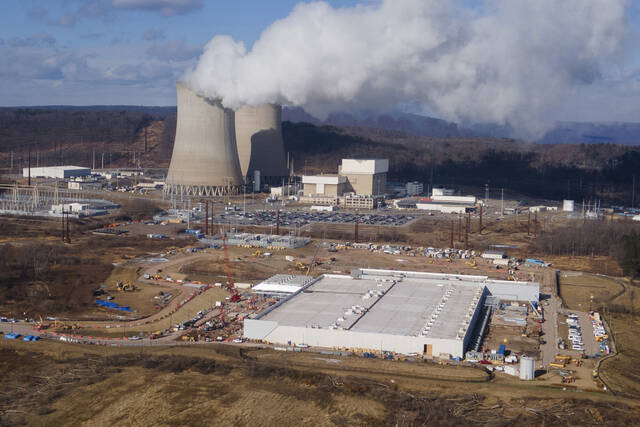
A data center owned by Amazon Web Services, front right, is under construction next to the Susquehanna nuclear power plant in Berwick on Jan. 14, 2025.
AP File Photo
Data center zoning amendment proposed for 20 municipalities
Deliberation will begin next week on a proposed Luzerne County Zoning Ordinance amendment covering data centers.
If approved, the ordinance will take effect in 20 municipalities that rely on county zoning instead of handling it on their own.
Those municipalities are: the boroughs of Avoca, Courtdale, Dupont, Duryea, Hughestown, Jeddo, Laflin, New Columbus, Pringle, Warrior Run, West Wyoming, and Yatesville, and the townships of Conyngham, Fairmount, Hunlock, Huntington, Lake, Newport, Ross, and Union.
Dan Reese, director of the county’s GIS, Planning, and Zoning Department, said staffers researched data center zoning protocols in other jurisdictions and collectively drafted a 10-page proposal that they believe comprehensively addresses all potential issues.
No data center requests are currently pending in the 20 municipalities, Reese said.
“We want to be proactive,” Reese said.
The proposal will first go before the county Planning Commission during its public meeting at 2 p.m. Thursday in the council meeting room at the county courthouse on River Street in Wilkes-Barre. Zoning ordinance amendments recommended by the commission must be approved by a County Council majority before they can be implemented.
Posted in the Planning Commission agenda at luzernecounty.org, the amendment defines data centers, specifies the zones where they could be permitted, and mandates that all data center requests require more extensive special exception approval from the county Zoning Hearing Board.
It defines a data center as a building or buildings primarily occupied by computers and telecommunications-related equipment where digital information is processed, transferred, and/or stored. This includes cryptocurrency mining, blockchain transaction processing, and server farms.
The ordinance also covers pre-engineered or prefabricated modular data centers and a range of accessory structures that support data centers, such as electrical substations and water-cooling and wastewater-treatment facilities.
Data centers fall under three categories in the ordinance based on size:
• Hyperscale: a single structure or campus of at least 500,000 square feet
• Major: a single structure or campus ranging from 100,000 square feet to 499,000 square feet
• Edge: a single structure up to 99,000 square feet
Hyperscale and major data centers would only be considered in heavy industrial, light industrial, and mining zoning districts. Edge ones could be permitted in those three districts, as well as general business and highway business zones.
Data center projects would have to comply with a series of standards detailed in the proposed amendment, it said.
For example, a setback of 500 feet is mandated from the boundary of residential zoning districts, agricultural and conservation zones, with a residence or the lot line of any property containing a “sensitive receptor.”
In addition to residential structures, receptors include schools, preschools, daycare centers, in-home daycares, long-term care facilities, retirement and nursing homes, community centers, places of worship, parks (excluding trails), recreational facilities, agricultural and conservation lands, campgrounds, prisons, and dormitories, it said.
Landscape buffers at least 50 feet wide would be necessary between a data center and any adjoining sensitive receptor or public roadway, it said.
Applicants must demonstrate, through a sound study conducted by a professional acoustical expert, that the sound generated will be under specified decibel limits.
Centers using non-public water sources must provide a water feasibility study to determine if there is an adequate supply for the proposed use and estimate the impact on all existing wells, groundwater, and surface water in the vicinity. Approval cannot be granted unless the study demonstrates that proposed water withdrawals and discharges won’t endanger or adversely affect the quantity and quality of groundwater and surface water in that area.
Regarding power, applicants who want to connect the data center to the electric grid must provide documentation from the applicable electric service provider certifying that the necessary capacity is available and will be provided.
“Known impacts on electric rates or availability for other uses directly attributable to the data center project shall be noted,” the amendment said.
All new electric lines, both transmission and distribution, must be located underground, it said.
Aesthetics are also addressed, with a mix of design elements required for portions of the façade visible from a public right of way or residential area, so passersby and neighbors don’t have to look at an “uninterrupted blank wall.”
Other requirements include: emergency response plans reviewed and accepted by local fire and emergency services, and a decommissioning plan outlining protocols if data center operations discontinue.
The amendment encourages “community incentive packages” to “offset project impacts and promote county welfare,” such as funding or programs to assist public safety, health, education, community amenities, or infrastructure enhancements.
Reese said he believes the proposal is comprehensive and in compliance with zoning regulations that prohibit governing jurisdictions from outright banning data centers altogether.
Reach Jennifer Learn-Andes at 570-991-6388 or on Twitter @TLJenLearnAndes.