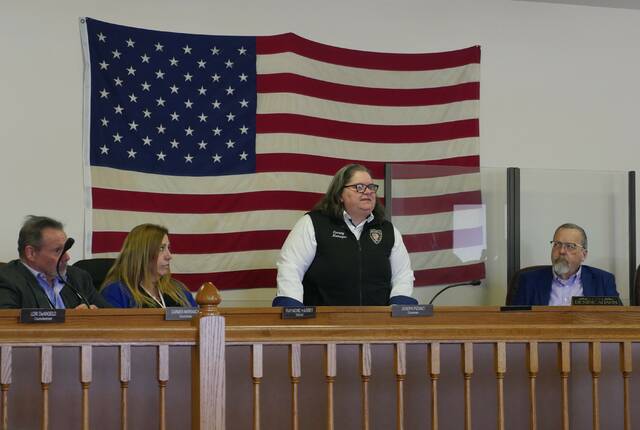
Luzerne County Manager Romilda Crocamo, standing, addresses attendees Tuesday during her latest town hall meeting at the Exeter Borough Building. Seated, from left, are: Chief Solicitor Harry W. Skene, Budget/Finance Division Head Mary Roselle, and Administrative Services Division Head Jim Rose.
Jennifer Learn-Andes | Times Leader
Luzerne County Manager Romilda Crocamo zeroed in on the county Election Bureau at the start of Tuesday’s town hall meeting in Exeter, saying the office “takes a lot of abuse.”
Elections are “very difficult to run,” with 186 precincts requiring voting equipment, poll workers who must be trained, and ballots to be tallied, she said.
“There are a lot of things going on at once. It’s a daunting task,” Crocamo said.
Crocamo noted a recent issue over ballot proofs posted online.
After reaching out to May 19 primary candidates by mail and text to verify their ballot information, county Election Director Emily Cook had posted a draft of the Republican and Democratic ballots online so the public could review the names and offices. Citizens were asked to email the bureau if they spotted any spelling issues or errors.
Cook later announced she was removing the proofing ballots from the county website due to unacceptable “instances of abusive behavior directed at our staff.”
Cook said her office detected confusing wording about the shading of bubbles and was in the process of correcting it as part of the proofing process still underway, intending to repost the samples. However, she said some citizens also noticed this wording and used the situation to accuse the office of incompetence.
Instead, the bureau will work with local party leaders and the county Election Board to ensure ballots are accurate, Cook had said.
During some elections, Crocamo said people spat “on our staff.”
“That’s what people do to them, and I won’t stand for it,” she told attendees.
As part of summarizing work in many county departments during Tuesday’s presentation, Crocamo said the election bureau has created an online training option for poll workers unable to attend in person, noting the county has approximately 1,200 poll workers.
The election bureau also collaborated with the county Election Board to streamline post-election ballot processing to ensure all deadlines are met, she said.
Six county division heads provided updates on departments they supervise: Jim Rose, administrative services; Mary Roselle, budget/finance; Megan Stone, human services; Paula L. Radick, judicial services and records; Michele Sparich, operational services; and Harry W. Skene, law division.
Crocamo said Acting Correctional Services Division Head Stanley Fiedorczyk was unable to attend due to commitments related to the death of a former corrections officer.
She told the audience of approximately 10 citizens and borough officials that the county must start discussing eventual plans for a new prison, while stressing the project would be years away.
A location would be the first decision, followed by the design, she said.
County officials have sporadically discussed the possibility of a new county prison for more than two decades because the existing aging, multistory facility on Water Street in Wilkes-Barre requires significant maintenance and has an inefficient layout.
The prison capacity was set at 250 inmates when it was remodeled around 1986, but it has largely run at double capacity since the 1990s through the use of bunk beds and conversion of day rooms into housing units, officials said.
Exeter Borough Council Vice Chairman John Morgan asked about traffic concerns related to the state-owned Spc. Dale J. Kridlo Bridge (Fort Jenkins) Bridge linking West Pittston and Pittston.
The nearby, county-owned Firefighters’ Memorial Bridge, commonly known as the Water Street crossing, closed in August 2021 due to concerns over a bent eyebar, prompting a dramatic traffic increase on the Fort Jenkins span.
The Pennsylvania Department of Transportation agreed to assume responsibility for replacing both bridges over the Susquehanna River as part of a bridge bundling package.
Crocamo said she will seek an update from the state because the county had agreed to help fund a temporary traffic signal and other safety measures at the state-owned crossing to address concerns until the new county bridge is constructed.
County officials said the bridge replacement project is taking years, largely due to numerous required state and federal regulatory studies and permits. Crocamo said she expects to see “some physical activity” at the county-owned bridge in 2027.
At another closed county-owned bridge over the Susquehanna — the Nanticoke/West Nanticoke crossing connecting Nanticoke and the West Nanticoke section of Plymouth Township — Crocamo said she and Sparich just received notification that someone cut the security fence.
Crocamo closed the bridge a year ago after engineers performing an inspection found further deterioration and section loss of primary, load-carrying components.
This is the third or fourth time the fence was cut, prompting the need for a security camera and a request for increased police patrols, Crocamo said.
Nobody should be on the bridge because it “could collapse by its own weight” at any point, she said.
The county has retained Modjeski and Masters Inc. to proceed with the preliminary design phase of the Nanticoke/West Nanticoke Bridge project, which is expected to take two years.
In addition to $10 million in federal funding allocated through the state for this project, the county has access to a $55 million casino gambling fund established for county infrastructure. Because federal funding is involved, the engineer must first develop three options for the bridge, officials said.
Reach Jennifer Learn-Andes at 570-991-6388 or on Twitter @TLJenLearnAndes.