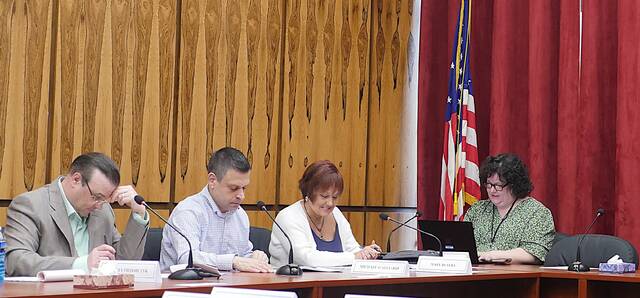
Luzerne County’s Commission on Opioid Misuse and Addiction Abatement unanimously voted Wednesday to recommend three more opioid litigation settlement fund earmarks totaling $2.65 million to County Council for its consideration. Commission members include, from left: Acting Correctional Services Division Head Stanley Fiedorczyk; county Drug and Alcohol Administrator Michael Gagliardi; citizen Mary Butera; and county Human Services Division Head Megan Stone.
Jennifer Learn-Andes | Times Leader
Luzerne County’s Commission on Opioid Misuse and Addiction Abatement unanimously voted Wednesday to recommend three new opioid litigation settlement fund earmarks totaling $2.65 million to County Council for its consideration.
The lion’s share — $2.2 million — would cover 2027 and 2028 costs for injectable medications in the county prison’s medication-assisted treatment program.
County officials implemented the program in 2023 for inmates experiencing opioid withdrawal. Some inmate suicides had been largely blamed on the painful effects of opioid detoxification behind bars without the aid of a prescribed medication to reduce symptoms. The medication also helps with cravings to reduce recidivism, officials said.
In addition to the initial offering of daily oral medication, the prison later added injectable medications administered once a month. Prison officials said injectables have many benefits, including the inability for inmates to somehow retain the medication and give it to someone else in the facility.
Acting Correctional Services Division Head Stanley Fiedorczyk, who serves on the opioid commission, said Wednesday the medication-assisted treatment program is important.
“The best way I could say it is we need it because it’s working,” Fiedorczyk said. “I’d hate to see us lose funding on this when it’s a program that’s actually showing success.”
Citizen commission member Mary Butera, who regularly meets with inmates in her work as a certified recovery specialist, said she fully supports the medication-assisted treatment program but believes it is underutilized.
“My concern is that if we can get them established prior to them leaving incarceration, it would be beneficial to not only them, but to society as a whole,” Butera said.
Fiedorczyk and representatives of the prison’s outside medical services provider, Wellpath LLC, both told Butera that expansion efforts are underway to reach all inmates who would benefit from the treatment.
Approximately 6.4% of inmates are typically in the program based on the fluctuating population, Wellpath representatives said after the meeting.
In a current snapshot reading, 18 inmates are currently receiving injectables, while three are on oral medication, Wellpath said. The breakdown: 22 men and 12 women.
Most of the inmates in the program enter residential or outpatient treatment programs upon release, Wellpath said. The representatives noted many inmates also require treatment during incarceration for other underlying medical issues stemming from their opioid use disorder, including infectious diseases.
Injectables are more expensive, Wellpath said. County Human Services Division Head Megan Stone, also an opioid commission member, said the $2.2 million would fund both the injectables and costs associated with administering them for two years.
Butera said she has witnessed people benefitting from injectables because they no longer require daily doses.
“Their whole life just seems to change,” she said.
The other two funding recommendations approved Wednesday:
• $172,000 for the county’s adult treatment court to partially cover the salaries of two case managers, a probation officer, and the treatment court coordinator
• $282,551 for The Wright Center for Community Health’s ongoing recovery “Healthy MOMS” program to continue providing medication-assisted treatment for pregnant and postpartum women and expand treatment for babies born with neonatal abstinence syndrome.
The three recommended earmarks will be placed on the agenda for a future County Council work session for discussion.
County District Attorney Sam Sanguedolce, county Manager Romilda Crocamo, county Drug and Alcohol Administrator Michael Gagliardi, and county Councilman John Lombardo also serve on the commission.
Council has authorized approximately $7.9 million in earmarks since 2023. The county is projected to receive approximately $30 million over 18 years from the state’s settlement against opioid manufacturers and wholesale distributors.
Council discussed three other pending requests during its Tuesday work session that would require majority council approval at a future meeting to take effect: $60,000 to the Children’s Service Center of Wyoming Valley to help with patient insurance copay and deductibles related to substance use disorder treatment; $268,600 to help renovate and support the Clem-Mar House-Meridian Recovery House in Wilkes-Barre that will serve up to 30 women in recovery; and $2 million to True North of NEPA for its new substance use disorder treatment center on Courtright Avenue in Wilkes-Barre, which is near the county prison and emergency management properties on Water Street, and is expected to open in May.
The commission had recommended the first two but did not take a position on the True North earmark.
Reach Jennifer Learn-Andes at 570-991-6388 or on Twitter @TLJenLearnAndes.