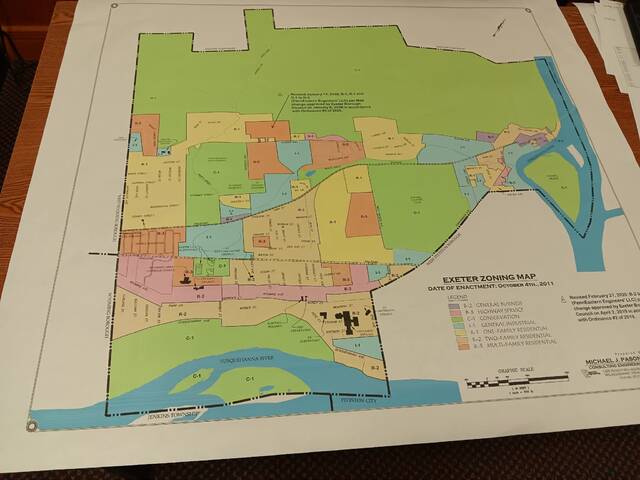
The portions of this Exeter Borough zoning map marked in light blue are industrial zones where data centers will be permitted.
Margaret Roarty | Times Leader
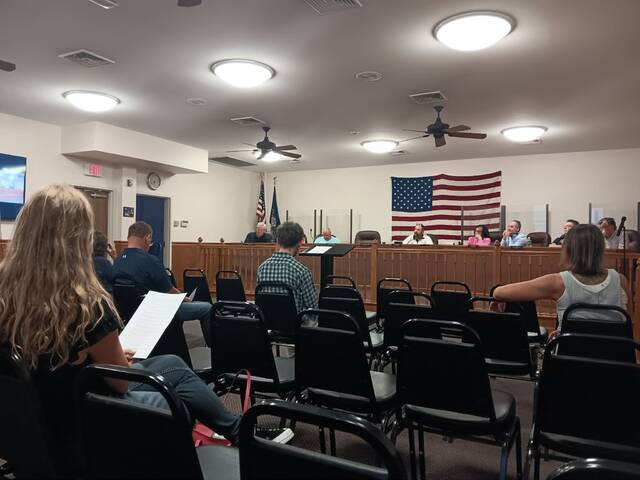
EXETER — Exeter Borough Council, during its regular meeting on Tuesday, approved an amendment to the zoning code that sets rules and standards for any future data centers in the borough.
A short public hearing was held at the municipal building before the council voted, during which the public had the opportunity to comment on the ordinance, which defines data centers and their accessory uses and sets regulations for the facilities.
“Data centers are kind of cropping up all over the area, as you know, and right now, many municipalities aren’t prepared for the type of use that data centers represent. They’re high energy users, they take big parcels of land, and use exorbitant amounts of water,” said council attorney Ray Hassey.
There are no known applications for a data center submitted to Exeter Borough at this time.
Data centers will be allowed in the borough in districts zoned I-1 (General Industrial) as a conditional use, which means approval of a data center project would have to go through the council.
As part of a conditional use package, applicants would need to submit a site plan for the proposed project, plans for electricity and water infrastructure, an emergency response plan, a decommissioning plan, a developer’s agreement, and documentation of required studies for noise, vibration, water, and environmental.
The ordinance also specifies that any proposed hyperscale or major data center development may include a community incentive package.
As defined in the ordinance, a community incentive package includes “Programs or contributions to public safety, health, education, community amenities, or infrastructure enhancements designed to offset project impacts and promote borough welfare.”
Additionally, some dimensional standards for data centers and their accessory uses include:
• The maximum building height for a data center shall be 60 feet, inclusive of roof-mounted equipment such as cooling and ventilation systems, HVAC units, and cooling towers.
• The maximum height of data center accessory uses shall be no greater than the height of the principal building.
• Data centers and data center accessory uses shall be set back 500 feet from the boundary of R-1, R-2, R-3, and B-2. B-3, and I-1 zoning districts, or the lot line of any property developed with a sensitive receptor.
• A landscape buffer is required between data centers and data center accessory uses and any adjoining residential zoning districts, including agricultural and conservation zones with a residence, sensitive receptor, or public roadway.
The ordinance also includes standards for noise and vibration, water and sewer, power supply, emergency management, parking, and decommissioning.
One resident, Vanessa Smith, spoke during the hearing. She asked whether an applicant would be subject to a 30-day waiting, and Hassey said there would be.
“I personally would just like to say I hope we never get one,” Smith said.
“We can’t discriminate against ‘em if they do come, but we can protect the borough,” said Vice Chairman John Morgan.
The full ordinance can be read on the Exeter Borough website.
Possible Kratom ordinance
Also at Tuesday’s meeting, council gave their solicitor the go-ahead to begin drafting an ordinance to regulate Kratom in Exeter Borough and to work with the solicitors of the other municipalities that make up the Wyoming Area Regional Police Department to do so.
This decision comes following a Luzerne County Court case in which the owner of KB Crash Creations, a Kratom plant in West Wyoming, pleaded no contest to 14 quality of life complaints after residents complained of a toxic smell in the neighborhood.
According to the FDA, Kratom, a tropical tree native to Southeast Asia, is often used to self-treat conditions like pain, anxiety, and depression, and can produce an opioid and stimulant-like effect.
The National Institute of Drug Abuse said there are several safety concerns with the herbal substance, including harmful contaminants, and that adverse effects range from mild to severe.
Wyoming Area Regional Police Chief Michael Turner also said U.S. Rep. Rob Bresnahan sent a letter to the Drug Enforcement Administration, urging action to put in place a temporary ban on Kratom until permanent legislation is passed and issued by the United States Congress.