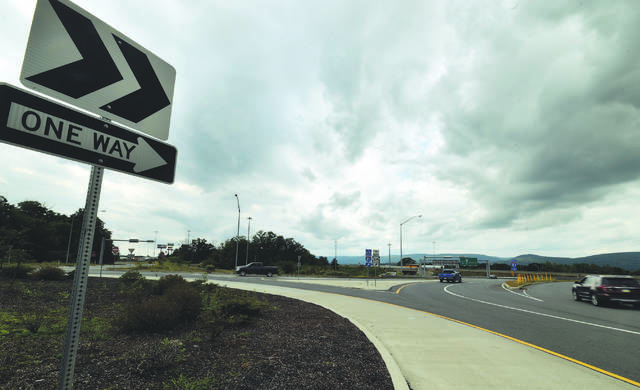
The roundabout on 315 near the Wilkes-Barre/Scranton International Airport is seen in this file photo. PennDOT Secretary Yassmin Gramian this week said she continues to be encouraged by the safety advantages of the modern roundabout.
PennDOT Secretary Yassmin Gramian this week said she continues to be encouraged by the safety advantages of the modern roundabout.
The Pennsylvania Department of Transportation (PennDOT) announced that fatalities, injuries, and crashes decreased overall at 22 roundabouts at 19 locations after they were built, according to department data.
“Lives are being saved and injuries reduced,” Gramian said. “The data cannot be denied.”
PennDOT recently reviewed data for 22 roundabouts on state routes at intersections that were previously stop or signal controlled. These roundabouts were selected based on having at least three years of crash data available before and after the roundabouts were built.
Department data based on police-submitted crash reports spanning the years 2000 through 2019 shows that fatalities at these locations were reduced by 100 percent and the total number of crashes decreased by 24 percent.
The data also show:
• Suspected serious injuries were reduced by 78%;
• Suspected minor injuries were reduced by 62%;
• Possible/unknown severity injuries were reduced by 82%;
• Property damage-only crashes increased by 20%.
In addition to the 22 roundabouts meeting the selection criteria, 34 other roundabouts have been built on state routes and over 40 more are in design.
Included in the review were roundabouts near the Wilkes-Barre/Scranton International Airport.
PennDOT also found:
• Roundabouts are frequently installed to address intersections with safety issues but may also be installed to improve traffic flow as well as other reasons such as traffic calming, and to facilitate pedestrian mobility.
• Although roundabouts are safer and typically more efficient than traditional signalized intersections, they may not always be the best option due to topography or other reasons, such as property impacts, capacity issues and proximity to other intersections.
• Roundabouts are recognized by the Pennsylvania State Transportation Innovation Council (STIC) as an innovation that has become standard practice within the transportation community.
To educate Pennsylvanians on how to navigate a roundabout, the department created a video on how to use both single and multi-lane roundabouts whether in a vehicle, on a bicycle or on foot. The video can be accessed by visiting the roundabout page on www.penndot.gov or by visiting the department’s YouTube channel.
Reach Bill O’Boyle at 570-991-6118 or on Twitter @TLBillOBoyle.