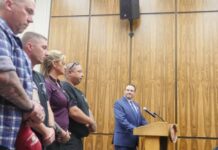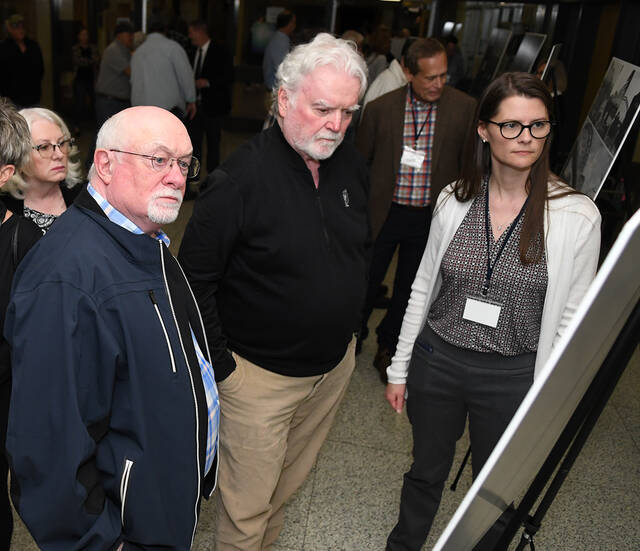
Engineer Rachel Tereska, right, was posted by large renderings of the Fort Jenkins (Spc. Dale Kridlo Memorial) Bridge and the Water Street (Firefighters’ Memorial) Bridge to answer any questions from the public prior to the main meeting of the evening.
Tony Callaio | For Times Leader

Over 200 local residents were present at the Wyoming Area Secondary Center auditorium on Wednesday evening with Tim Benner, McTish-Kunkel & Associates vice president, far left, addressing the audience during a slide presentation.
Tony Callaio | For Times Leader
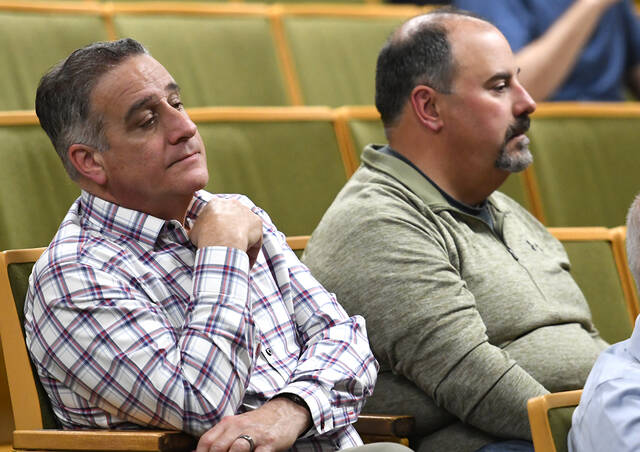
City of Pittston Mayor Michael Lombardo, left, and West Pittston Mayor Angelo Alfano, intently listen to the presentation by McTish-Kunkle & Associates on options for the future of the two bridges that connect Pittston and West Pittston.
Tony Callaio | For Times Leader

The West Pittston Historical Society was represented by Tom Obzut and Mary Portelli for the presentation of the two bridges that connect West Pittston and Pittston.
Tony Callaio | For Times Leader
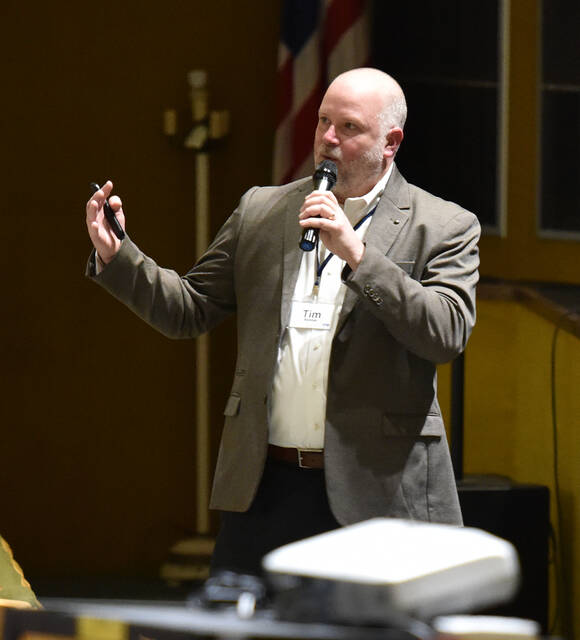
Tim Brenner, McTish-Kunkel & Associates engineering firm vice president, conducted the meeting regarding the fate of the Water Street Bridge and the Fort Jenkins Bridge, now named the Firefighters’ Memorial Bridge and Spc. Dale Kridlo Memorial Bridge, respectively.
Tony Callaio | For Times Leader
EXETER — With the future of critical infrastructure at stake, more than 200 area residents attended a Wednesday night briefing on options for two bridges linking West Pittston and Pittston.
A Pennsylvania Department of Transportation consultant guided them through maps and explained the pros and cons of rehabilitating or replacing one or both of the bridges at issue: the Luzerne County-owned Firefighters’ Memorial Bridge (Water Street) and state-owned Spc. Dale J. Kridlo Bridge (Fort Jenkins) over the Susquehanna River.
The “best apparent alternative” the state is pursuing would replace the Water Street span and rehabilitate or replace the Fort Jenkins one — keeping their existing footprints. This would maintain familiar traffic patterns and keep local connections, the presentation said.
The audience at the Wyoming Area Secondary Center collectively groaned when presenter Timothy Benner, of McTish-Kunkel and Associates said the state does not expect the project will go out to bid until 2026. The state will expedite plans as much as possible but must follow required procedures, he said.
The county-owned bridge has been closed since August due to concerns over a bent eyebar, causing significant vehicle congestion. Traffic on the nearby state bridge has increased from 12,000 vehicles to 20,000 per day with the county span out of commission, officials said.
Under an agreement approved by county council, the state will assume responsibility for the design and construction of the yet-to-be-finalized solution for both bridges.
The county would only pay 5% toward the cost of refurbishing or replacing its bridge, with the rest coming from state and federal funding. However, the state transportation department would have the option to terminate the agreement if it does not receive the federal or state funds necessary to complete the project.
An estimated $50 million would be needed to replace both spans, which includes river surveying, design, permitting and demolition of the current bridges, officials said.
County Acting Manager Romilda Crocamo and several county council members attended Wednesday’s briefing.
Councilman Kevin Lescavage said he prefers the option to replace both spans using the same footprint, saying it will ensure both river crossings are built to current standards and last longer.
Council Vice Chairman John Lombardo said he would prefer rehabilitation of the historic Water Street span so it could “continue to be part of the skyline for Pittston.”
Built in 1914, the Water Street span was last rehabilitated in 1984 and is not designed for today’s traffic loads, Benner said.
It has significant corrosion and rust around the eyebars and the original supporting piers shown in the 1914 construction photograph he presented to the audience.
“They’ve done their job. They’ve been out there for a long time,” Benner said of the piers.
The Water Street Bridge would cost $20.5 million to replace and $22.5 million to repair and would still be posted at a 20-ton limit if it is repaired, Benner said.
The Fort Jenkins span was built in 1926.
Other options included:
• Removing the Fort Jenkins span and constructing a new Water Street crossing connecting Luzerne Avenue in West Pittston to William Street in Pittston instead of Water Street on the Pittston side.
• Removing the Water Street span and realigning the Fort Jenkins one by shifting its position.
With the plan to keep both bridges, the Water Street span would be addressed first and then hold all traffic while work on the Fort Jenkins one is completed, Benner said.
Crocamo said she does not advocate reopening the Water Street span during the planning stage due to the cost and safety issues, citing photographs of the damage as evidence it should not be used in its current state.
The county, municipalities and PennDOT have jointly developed a plan to change traffic signals to improve traffic flow and safety in the area of the closed bridge and increase blockades to prevent pedestrian traffic over the bridge, she said.
After public comment is received, the state will complete its analysis of alternatives so that one may be selected and advance to final design, officials said. Attendees of Wednesday’s session received forms to submit comments and questions on the proposed options and interim measures to alleviate traffic congestion.
Much of the information presented Wednesday is posted at https://www.penndot.pa.gov/RegionalOffices/district-4/PublicMeetings/Luzerne%20County/Pages/SR-11-Bridge-Project.aspx along with a link to submit public comment.
As Wednesday’s presentation wrapped up, Pittston area resident Jim Zarra said his preference would be rehabilitating both spans, noting they are featured prominently in old postcards and other historical material of both Pittston and West Pittston. He also believes rehabilitation would speed up the work.
“It would keep the architecture of both the city and West Pittston’s historic districts intact,” Zarra said.
Reach Jennifer Learn-Andes at 570-991-6388 or on Twitter @TLJenLearnAndes.