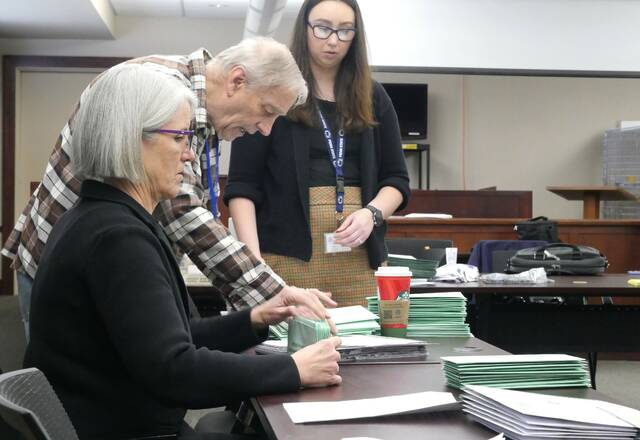
Luzerne County Election Board Chairwoman Christine Boyle, in foreground, then-board member Daniel Schramm, and county Election Director Emily Cook process ballots after the November 2025 general election.
Jennifer Learn-Andes | Times Leader File photo
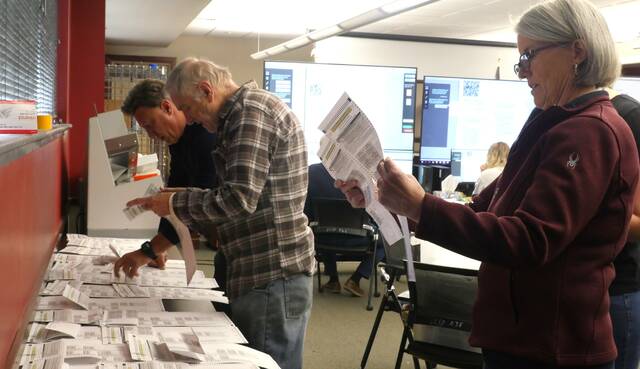
Luzerne County Election Board Chairwoman Christine Boyle, in foreground, then-board member Daniel Schramm, and Board member Rick Morelli examine ballots following the November 2025 general election.
Jennifer Learn-Andes | Times Leader File photo
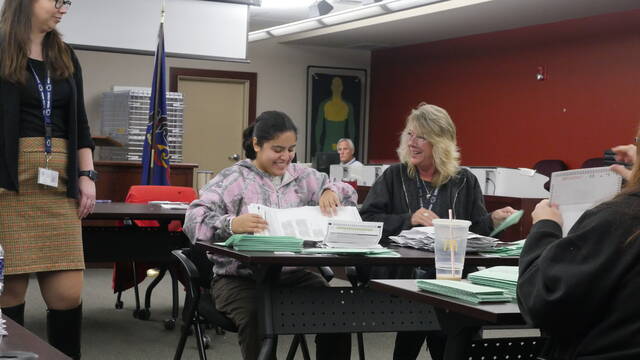
Luzerne County election workers prepare accepted general election provisional ballots for tallying after the November 2025 general election as county Election Director Emily Cook, standing at left, supervises.
Jennifer Learn-Andes | Times Leader File photo
Luzerne County’s bipartisan Election Task Force will hold a public meeting next month to discuss its final recommendations on ways Pennsylvania can clarify and streamline election procedures.
State senators and representatives have been invited, and citizens are urged to attend the session at 6 p.m. on April 16 at the county courthouse on River Street in Wilkes-Barre, according to an announcement from county Administrative Services Division Head Jim Rose, the task force moderator.
A remote attendance option will be available for those unable to attend in person, Rose said.
County Manager Romilda Crocamo formed the 14-citizen group after the 2024 general election to identify state election code updates that will be pitched to state legislators. The task force started meeting in March 2024.
“The Task Force has identified eight key areas for improvement and strongly encourages the Commonwealth to adopt these measures to strengthen election integrity, improve efficiency, and enhance voter confidence,” Rose said.
The recommendations are expected to include changes in the mail ballot application deadline and processing timeline.
Voters currently have until a week before the election to apply for mail ballots, and election officials across the state have argued this window is too short for voters to both receive and return their ballots.
Regarding processing, counties must wait until Election Day to perform the initial unsealing and processing of mail ballots, known as pre-canvassing. Allowing counties to start pre-canvassing sooner would ensure they are caught up, so the tallying of results is not delayed, election officials have argued.
It should be noted that counties cannot start recording and reporting mail ballot results until after the polls close at 8 p.m. on Election Day.
Provisional ballots also likely will be addressed in the recommendations based on past experiences.
Provisional paper ballots are cast at polling places, typically when workers determine that additional voter verification is needed. The county reviews provisional ballots last to ensure the voters are properly registered and did not cast a second ballot by mail.
After every election, the county’s five-citizen Election Board encounters signature problems and other issues with provisional ballots during its adjudication review process.
County election officials also have complained about the state’s voter database used by all 67 counties, known as the Statewide Uniform Registry of Electors, or SURE, system. The state had announced plans in March 2025 to implement a new streamlined elections management system that would eventually replace SURE and other current elections-related programs.
Election Task Force member Linda Joseph, of Wilkes-Barre, said Thursday she looks forward to the public release of the recommendations.
Joseph has attended numerous county Election Board post-election adjudication sessions and board meetings in which election concerns were discussed.
She promptly volunteered for the Task Force, saying it is “really important to see if we could get changes made on a state level.”
“I have been following the election procedures and the state election code and realized that there seem to be things in general that really don’t make sense and are causing issues and impacting both the Election Bureau and voters,” Joseph said.
Joseph said the group’s focus was on improving the state law governing election procedures, not on internal bureau operations. She emphasized the group’s determination of the eight recommendations was bipartisan.
“This was about making the code better for everybody, to improve the voting systems and procedures for everybody,” Joseph said.
Reach Jennifer Learn-Andes at 570-991-6388 or on Twitter @TLJenLearnAndes.