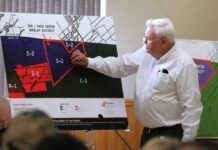
Tom Melone, whose firm is the district’s business manager, gives a final budget presentation.
Sydney Allabaugh | Times Leader
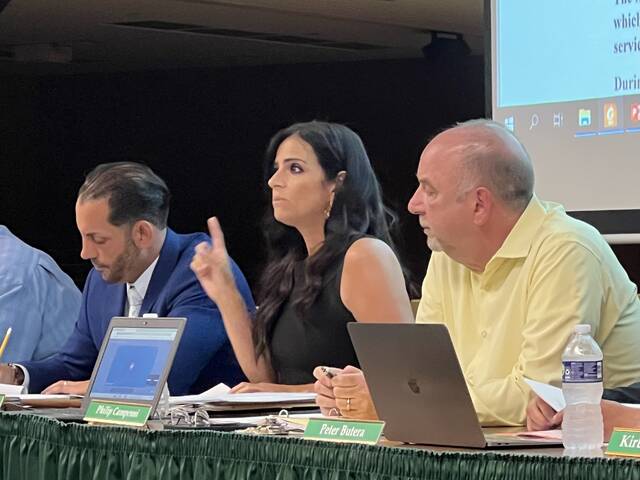
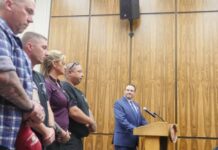
Board President Mara Valenti addresses concerns raised about Wyoming Area’s budget.
Sydney Allabaugh | Times Leader
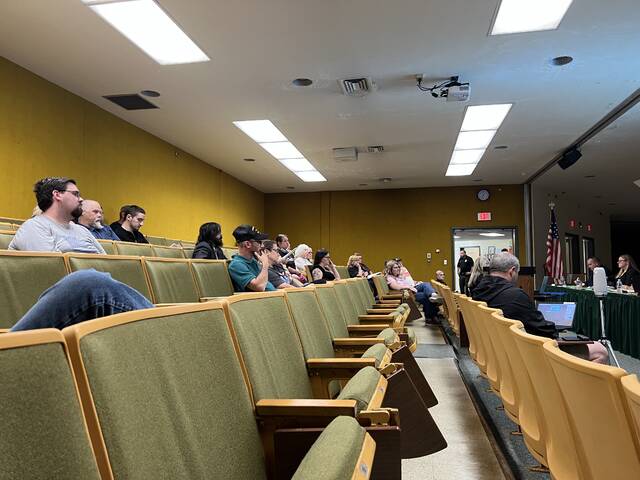
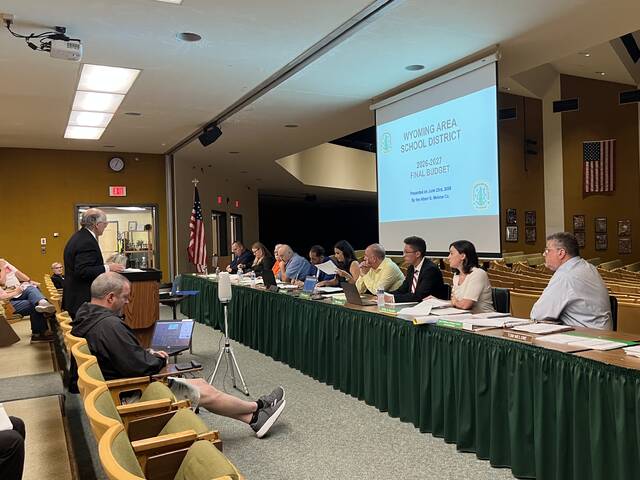
About 20 people attended the Wyoming Area School Board meeting Tuesday.
Sydney Allabaugh | Times Leader
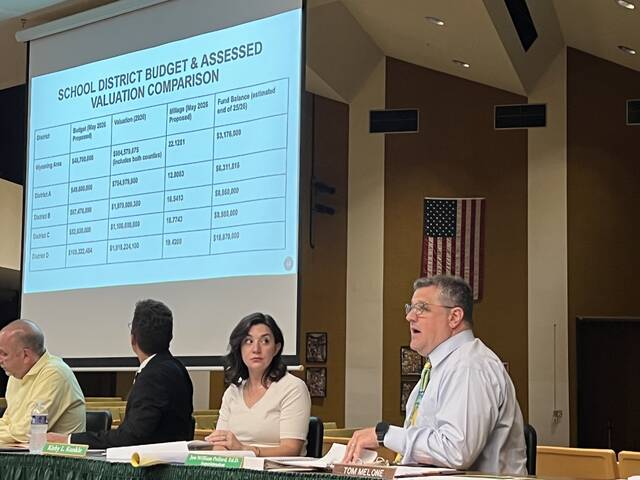
Superintendent Jon Pollard compares Wyoming Area’s budget to those of other area school districts.
Sydney Allabaugh | Times Leader
EXETER — The Wyoming Area School Board approved a final budget for the 2026-27 school year on Tuesday with a 4.8% property tax increase at Pennsylvania’s Act 1 index limit.
The budget passed in a 7-2 vote, with board members Philip Campenni and Peter Butera voting against it.
The tax increase will generate $837,151 in revenue for the district. The final budget outlines $49.53 million in expenditures and $48.36 million in revenue, excluding nearly $450,000 in anticipated state subsidies.
The district can draw from its $3.18 million fund balance to cover the gap, which is projected to leave just over $2 million remaining at the end of the 2026-27 school year.
Notably, under Pennsylvania law, school districts that span multiple counties must rebalance their millage rates so that the ratio of taxes to market value is uniform across all counties in the district.
For this reason, Luzerne County residents will see a 3.94% tax rate increase to 22.6469 mills, and Wyoming County residents will see a 9.86% tax rate increase to 119.4070 mills. A mill is $1 in tax for every $1,000 of assessed property value.
Superintendent Jon Pollard and Tom Melone, whose firm is the district’s business manager, spoke out against state-mandated tax rebalancing efforts, noting the district recently sent a letter to state legislators requesting changes. The letter argued districts are required to use outdated market value data when rebalancing tax burdens, which can result in artificial and dramatic shifts in taxes between counties.
“We have a revenue problem”
Board President Mara Valenti emphasized year-after-year tax increases are not a result of frivolous spending.
She highlighted numerous efforts by the school district to cut costs, like switching insurance carriers and mechanical service providers, and eliminating two administrative positions and at least two teaching positions through attrition. The school district also added two autistic support classrooms, with plans for more, to save on out-of-school tuition costs.
“We have made the cuts, and unfortunately, our kids are the ones paying for it,” Valenti said, noting that student-athletes sometimes have to use sports facilities at other schools. “We don’t have these glorious facilities. Our kids are doing without because of how lean we are.”
“We do not have a spending problem,” she said. “We have a revenue problem.”
Valenti, Pollard, and Melone detailed the district’s struggle to generate revenue.
“Over the years, our biggest challenge has been the drop in assessed valuation,” Melone said, noting the impact of flood devastation.
The district’s total assessed property value fell by more than $20 million between 2015 and 2024, increased by about $7 million since 2024, largely due to the construction of a Sheetz, and has since plateaued at about $984.6 million, Melone said.
Valenti said the neighboring Pittston Area School District, which has not raised taxes in six years, has significantly more industry, while also receiving about 44% of its funding from the state.
Pollard noted that Wyoming Area receives millions of dollars less in adequacy and foundation funds from the state’s Ready to Learn Block Grant than area school districts with similar profiles.
“I feel that the data that they’re using in that funding formula, that adequacy formula, is outdated,” Pollard said.
Rising costs
While the district struggles to generate revenue, mandatory expenses, like employee healthcare and cyber charter costs, continue to rise.
Valenti said the district expects a 14% increase, about $750,000, in health care costs through Northeast Pennsylvania School Districts Health Trust, which she said remains the most affordable provider. Pollard said school employees pay about 2% toward their health care.
“If we were to go to the index tonight, that just basically covers the increase cost in health care,” Valenti said.
Melone’s budget presentation noted cyber charter tuition cost the district $2.83 million in the 2025-26 school year, up from $2.78 million last year, and $668,951 million in the 2016-17 school year. The $2.83 million tuition covers about 150 students, Pollard said.
Board member Anthony Burke told about 20 attendees at the meeting that taxpayers are effectively funding students’ private education, despite Wyoming Area offering its own cyber school option.
“We can’t stop the tax hike because of what’s going on with charter cyber school,” Burke said. “It’s out of our hands with that.”
Burke and several other board members said they have raised the issue with state representatives and encouraged taxpayers to do the same.