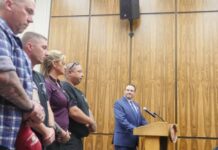
Rosencrans
Luzerne County 911 Executive Director Fred Rosencrans brought a team to last week’s county council meeting ready to answer any questions about the emergency radio communication system upgrade project expected to go live this summer.
“I’ve been transparent from the beginning. We have nothing to hide,” Rosencrans said.
Six council members voted during the meeting to form an inquiry committee to review the project, but the action failed because the council-adopted administrative code requires seven votes — a majority plus one — for such an action.
Some of the council members insisted they merely want to review expenditures and are not implying any wrongdoing.
“I don’t want the 911 people to think we’re investigating,” said Councilman Brian Thornton, who voted to create the committee along with Carl Bienias III, Kevin Lescavage, LeeAnn McDermott, Stephen J. Urban and Gregory Wolovich Jr.
However, Rosencrans said it was publicly stated in the past the council members are seeking an investigation and that an accusation of “piecemealing was thrown out there publicly.”
“I certainly did not piecemeal this project as alleged,” Rosencrans said, referring to the illegal practice of purposefully breaking big contracts into smaller ones to favor vendors.
Council members John Lombardo, Tim McGinley and Chris Perry voted against the committee formation. Council Chairwoman Kendra Radle was absent but has said she does not support a committee. A council seat formerly held by Robert Schnee is vacant.
Lombardo, council vice chair, said Rosencrans has exhaustively answered questions and furnished any requested information on the project, which is designed to address spotty or nonexistent emergency radio coverage and convert from analog to digital equipment.
”I think it’s a serious, serious waste of our time and a serious waste of taxpayer money,” Lombardo said of a committee. “It’s not necessary.”
After the committee creation failed, Urban referred to the seven-vote requirement, stating, “That’s fine. We’ll change the administrative code the next round.”
Council questions
During a lengthy discussion last week, Thornton told Rosencrans he is concerned the project is about $7 million over what was initially planned.
McGinley said that $7 million always had been publicly disclosed as the cost of a 20-year support and maintenance agreement that includes round-the-clock monitoring and assistance and two hardware/software “refreshes” after seven and 14 years to ensure it continues to meet needs.
Rosencrans verified McGinley’s assessment and said there is no decision for council to make on the $24.7 million radio system contract with Motorola Solutions Inc. because it was approved and awarded by 10 of 11 council members in 2019.
“So I don’t know where this is going to go or what this is all about, but the contract is in place. That ship sailed,” Rosencrans said. “If you want to negate that contract, there could be law infractions, civil implications.”
Thornton asked if there were eight costly change orders, or alterations to the project, and whether there will be more.
A Motorola representative told council all but one of the change orders were zero-dollar because they involved administrative adjustments. The one requiring a cost was approximately $10,000 to change to a magnetic mount of 911 communication equipment on a water tank at the Eagle Rock residential development in Hazle Township, he said.
Rosencrans said the project team decided a magnetic mount would be a better option than one welded to the tower to avoid the need for a diver to inspect the welding and the liability exposure if the water tower bladder is damaged.
“Can I just ask where you’re getting that information that they were very costly?” Rosencrans asked Thornton. “I’m not trying to be adversarial or confrontational, but they’re zero dollar change orders.”
Thornton said he should not have used the word costly but said eight change orders could be an indication for governing bodies that the project was not properly planned.
“My stance from the beginning is that I don’t want to see a change order, and if there are, I want zero-dollar change orders,” Rosencrans replied.
Lescavage questioned if the new system will keep pace with advances, saying new and better technology may be available several years from now.
John Ankenbrand, a 911 technical support supervisor, told Lescavage the county wanted the 20-year support from Motorola to guarantee the system stays updated and does not have to be replaced after a few years.
“They’re contractually bound now for the next 20 years to support our system,” Ankenbrand said.
Ankenbrand described the system as “fantastic” and said the only additional requests would be for new public safety enhancements if money becomes available.
For example, 911 is asking council to consider earmarking $3 million of the county’s federal American Rescue Plan funding to add components that will transmit the GPS coordinates of emergency responders and allow 911 personnel to remotely connect to the more than 4,000 emergency radios in the field so they don’t have to physically hold them to complete software and firmware updates.
McDermott said she was informed a fire/emergency services agency purchased radios that are not compatible with the new system, even though it had reportedly checked with the county to verify they would be permissible.
Rosencrans said 911 has, on multiple occasions, released a list of all compatible radios along with software and features required for the new county system.
The county also purchased more than $8 million in Motorola mobile and portable equipment for police and other emergency responders to avoid issues with compatability, Rosencrans said.
Some agencies purchased radios from a Kenwood vendor that did not provide them with all features required for the county’s new system, Ankenbrand said.
“I instructed them they need to go back to their vendor and have the radio upgraded because they know what the requirements are,” Ankenbrand said.
Towers
As part of the project, the county added a new emergency communication tower off Harris Pond Road in Ross Township to increase emergency radio coverage in the Back Mountain. The state’s Fish and Boat Commission agreed to a no-cost lease for the county’s use of its site.
Four existing towers had to be replaced because the old ones were not structurally equipped to handle the new equipment in compliance with wind and ice-load standards, Rosencrans said.
The county is changing from 2-foot microwave dishes to 6-foot ones, Rosencrans has said. The replacement towers are in Freeland, Mountain Top, the Campbell’s Ledge area of Duryea and at the Emergency Management Agency in Wilkes-Barre.
Other tower sites required additional preparation work, including electrical remediation such as grounding, he said.
There are now 19 tower sites.
Lescavage asked why the project consultant did not examine the towers during planning to determine if any would have to be replaced as part of the project.
Jonathan Hansen, of project consultant MCM Consulting Group, said structural analysis is not completed before the project vendor is selected because the vendor must determine which towers will be needed and the size of the dishes that will be used to provide the required coverage.
In this case, Motorola selected some of the existing towers and added more, he said.
Wolovich asked if there will be additional new tower requests.
Rosencrans said he does expect additions based on preliminary testing, but Motorola is “literally on the hook” to install tower sites if more are needed.
Motorola is contractually bound to provide 95% emergency radio coverage, 95% of the time, over the entire 980-square-mile, largely mountainous county, including remote areas and the ground floors of structures in both urban and suburban communities, he said.
The system will provide a minimum digital audio quality of 3.4, which is the industry standard, Rosencrans said.
Rosencrans emphasized the county will be heavily testing in coming months to verify standards are met when leaves are on the trees. The county won’t sign off on the system until acceptance testing is completed, he said.
Even though the system is not yet fully activated, Rosencrans said he has used a five-watt portable radio in various areas that had coverage issues before, and the reception was “crystal clear.”
“This preliminary testing is phenomenal coverage compared to what we have today with the analog system,” he told council.
Holding one of the radios, Ankenbrand said he was able to stand in the courthouse basement and use the device to speak to a 911 supervisor in Nanticoke — something not possible before.
In the trenches
Hazleton Fire Chief Donald Leshko told council he was attending the meeting because he saw the inquiry committee was on the agenda.
Leshko said he was involved in the project since its inception and believes council should be proud, especially because the county took the added step of purchasing a large quantity of mobile and portable radios for emergency responders. He commended Rosencrans and his team for keeping local agencies informed in a “very open and straightforward” manner and setting up training.
The new system will end situations where responders must struggle to communicate through one radio frequency when dealing with multiple incidents, Leshko said. The change will allow two simultaneous conversations on one channel and increase the capacity, in part by making use of idle channels, officials have said.
“It’s not easy,” Leshko said of such situations. “I can’t wait for this system. I wish the system went online tomorrow.”
Leshko also urged council to approve American Rescue allocations for the GPS locator feature, saying it would be “worth every penny” if it saves one responder’s life.
Public school districts also will receive mobile radios with a panic button as part of the county upgrade, allowing school officials to instantly send a message if there is an emergency situation, Rosencrans said.
Jeff Balut also thanked council for supporting the new system and urged addition of the GPS component and remote programming features. Currently a school police officer at the Bear Creek Charter School, he previously worked as a state police commander at the Tunkhannock and Shickshinny stations and as Hughestown police chief.
Balut said he covers a 350-acre campus at the charter school and can already hear surrounding police activity through a new mobile unit installed in his vehicle. He said he had to use a cell phone to contact 911 due to coverage issues with the current analog system.
“What I’ve seen of coverage so far has been absolutely fantastic,” Balut said of the new system. “Now I can communicate with the county.”
McDermott thanked attendees for explaining the system, saying she and others joining council since the program’s inception had not received all the information.
After the meeting, Rosencrans urged any agencies with concerns or questions to contact 911 or reference the project website, luzernep25.org.
Reach Jennifer Learn-Andes at 570-991-6388 or on Twitter @TLJenLearnAndes.