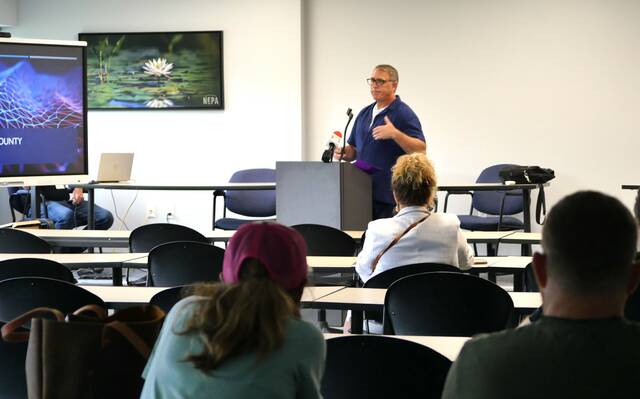
Luzerne County Chief Artificial Intelligence Officer and First Assistant Solicitor Vito DeLuca briefs citizens on the county’s developing AI program during a Wednesday night town hall at the county Operations Building in Wyoming.
Jennifer Learn-Andes | Times Leader

Information slides from a town hall held Wednesday about the Luzerne County AI Pilot Program.
Courtesy of the Luzerne County AI Pilot Program via Zoom
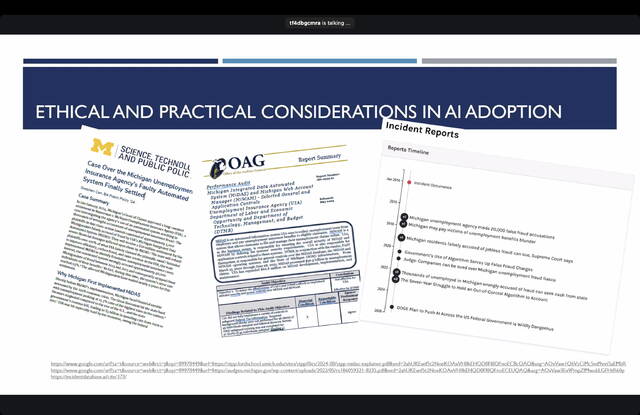
Information slides from a town hall held Wednesday about the Luzerne County AI Pilot Program.
Courtesy of the Luzerne County AI Pilot Program via Zoom

Information slides from a town hall held Wednesday about the Luzerne County AI Pilot Program.
Courtesy of the Luzerne County AI Pilot Program via Zoom

Information slides from a town hall held Wednesday about the Luzerne County AI Pilot Program.
Courtesy of the Luzerne County AI Pilot Program via Zoom

Information slides from a town hall held Wednesday about the Luzerne County AI Pilot Program.
Courtesy of the Luzerne County AI Pilot Program via Zoom
Luzerne County’s administration has selected Microsoft 365 Copilot GCC for its foray into the use of artificial intelligence but has not yet activated the program for use in any specific tasks, county Chief Artificial Intelligence Officer and First Assistant Solicitor Vito DeLuca said during a Wednesday night town hall.
“We’re taking baby steps for a reason,” DeLuca told the 11 citizens in attendance at the county Operations Building in Wyoming.
DeLuca said he understands the anxiety some expressed when the county officially launched “NextGen Luzerne County” in April, which was described as a groundbreaking pilot program exploring how AI can responsibly enhance the efficiency, transparency and delivery of public services.
Before proceeding, the administration must finalize an AI policy that is under development by the county’s Information Technology Department with his input, he said.
This policy will require all use of the new technology to be transparent and ethical, prohibit the use of personal data and mandate human review of any resulting data or other information, he said. The county also would require access to all controls, ownership of all data and capabilities to audit, he said.
The initial stage will primarily involve familiarizing representatives from many departments with AI capabilities so they can recognize opportunities to make operations more efficient, he said.
A change also is needed in the way county government data is created and stored to make it more conducive to AI solutions as more tools become available, DeLuca said.
He gave an example of departments taking unnecessary steps with PDF files that prevent speedy retrieval through computerized searches.
DeLuca said the most frequent question he receives from the public is for an explanation of AI. Borrowing a definition from Microsoft Copilot, he said it is the ability of a computer system to perform tasks that typically require human intelligence, such as learning, reasoning and decision-making.
But he emphasized much of the generative AI output is based on predicting words or images because there is no degree of human understanding with these programs.
The audience chuckled when DeLuca showed them an AI image produced from his request to use a photograph of his face to show him sitting on a T-Rex.
He showed another example of a man that, upon closer inspection, had an extra finger because that AI program did not properly set a limit on the digits.
DeLuca asked a detailed sample question about IT issues of concern to a county this size, and AI generated a lengthy report in 15 seconds — a task that would take an IT worker significantly longer. On a whim, he requested an AI transformation of that report into a rap song, prompting the receipt of lyrics for a song entitled, “County Lockdown.”
Still, human involvement is crucial, he said, providing examples of attorneys in other states that got in trouble for using AI to generate legal briefs that were not checked before they were filed with the courts. It turned out the cases cited in the briefs were not real.
AI generation of content that appears convincing but is incorrect or unrealistic is known as the “hallucination” concept, he said.
DeLuca pointed to examples of AI “solutions” that have failed elsewhere that he uses as case studies of mistakes that must be avoided by this county.
One program was supposed to predict which offenders were most susceptible to recidivism, but it was designed with tremendous racial bias, he said. Another intended to predict unemployment fraud had a faulty algorithm that resulted in 85% wrongful allegations.
DeLuca praised Allegheny County for following extensive steps in designing a screening tool to identify children in crisis but said it was still legally challenged over accusations of bias.
While such advanced programs are not under consideration here at this time, DeLuca said the AI plan now underway will ensure county workers are knowledgeable about AI so they can make educated decisions about viable smaller-scale options in the near future and possible larger ones down the road as technology evolves.
He expects the initial uses will involve using AI to summarize documents, prepare action plans and process data more efficiently.
The Microsoft 365 Copilot GCC program and training through BrainStorm will cost approximately $40 per month for each employee actively involved in the county AI program, DeLuca said. Approximately 35 are signed up, and it may reach 50, he said.
DeLuca said the Microsoft program does not require the county to lock in a contract for a set time period, and the county can shut it off at any time so there is no charge when it is not in active use.
Three citizens in attendance Wednesday voiced general reservations and skepticism over AI.
State Rep. Jamie Walsh, R-Ross Township, said discussion about AI is “extremely important” both locally and at the state level because policies are needed to ensure residents are comfortable with its usage.
“It’s a new playing field for everybody,” Walsh said. “We’re learning as we go.”
Reach Jennifer Learn-Andes at 570-991-6388 or on Twitter @TLJenLearnAndes.