WEST PITTSTON — Police departments on the west side of Greater Pittston are facing limited manpower, lean budgets and ever-increasing responsibilities.
For those reasons, police officers, including chiefs, often work in multiple municipalities.
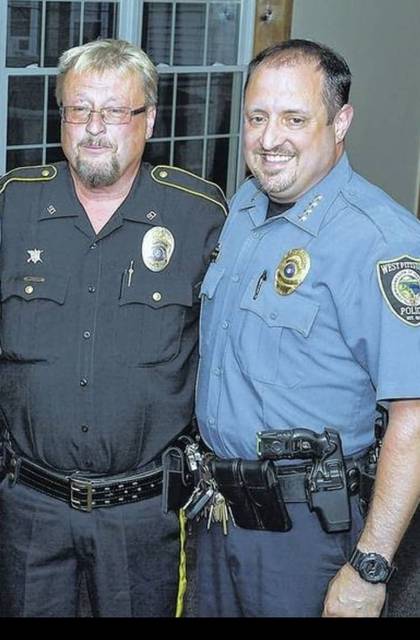
Following Wyoming Borough’s hiring of West Pittston Police Chief Michael Turner as a part-time officer last month, several residents inquired as to whether it is legal and safe to have a police chief from one town working part-time in another town.
Wyoming Police Chief Christopher Mercavitch, who also works part time as a West Pittston police officer, said the situation benefits both departments.
“In case of an emergency, the chief would be called to his own department,” he said. “We all work together.”
Mercavitch, who worked two shifts for the West Pittston Police Department last month, said he had been working part-time for the West Pittston department since before being named Wyoming chief earlier this year.
Turner, a Wyoming Borough resident, said officers work for other departments as a professional courtesy.
He will earn about $17 an hour part-time as a Wyoming Borough police officer.
Mercavitch said he makes “about $14” as an officer in West Pittston.
Mercavitch is paid apprxoimately $54,000 as Wyoming Police Chief.
Turner did not disclose his salary.
Other departments
Mercavitch emphasized that, in addition to Wyoming and West Pittston, other police department chiefs also work in other departments.
West Wyoming Council President Gary Stavish confirmed that Exeter Borough Police Chief Joseph Schlagel works part-time as a police officer in West Wyoming.
West Wyoming Police Chief Curtis Nocera works as a fire fighter in Plains, according to Stavish.
Stavish said he is not concerned with police officers, including police chiefs, committing to other service positions.
To Stavish, the situation “just makes sense.”
“In an emergency, each chief is head of his own department 24/7,” he said. “At other times, police officers can use their skills and training with other departments.”
“No downside”
At a time when many municipal governments are discussing regionalization but are reluctant to actually regionalize because of a commitment to the identify of its departments, many municipal governments utilize mutual aid and share police personnel across departments.
Both Stavish and Merkavitch emphasized the importance of police department personnel working together to keep residents safe, especially on Greater Pittston’s West Side.
Addressing questions about the importance of having a munipality’s chief on site during an emergency, Merkavitch said chiefs will always be available to respond to their home territories during an emergency, as well as working in conjunction with other departments.
During a standoff in West Pittston in July, police and emergency responders from across the Greater Pittston Area responded, in addition to county and state law enforcement agencies.
“There is no downside,” said Mercavitch.