
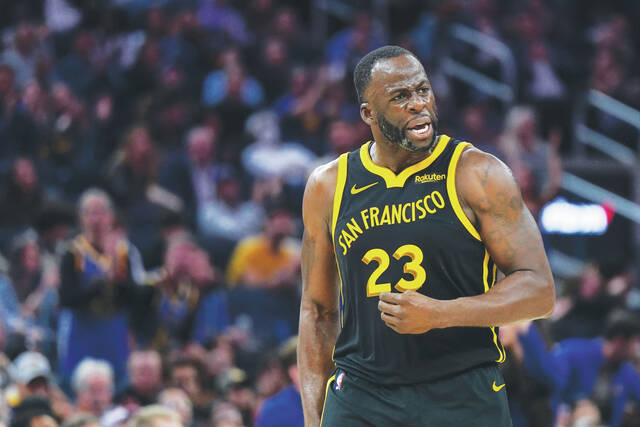
Golden State Warriors forward Draymond Green during an NBA game against the Cleveland Cavaliers earlier this month in San Francisco.
The National Basketball Association season is still young, but already Draymond Green of the Golden State Warriors is making headlines for the wrong reasons.
That shouldn’t surprise anyone.
A recent announcement from NBA Communications reported Green “has been suspended five games without pay for escalating an on-court altercation and forcibly grabbing Minnesota Timberwolves center Rudy Gobert around the neck in an unsportsmanlike and dangerous manner.”
Joe Dumars, NBA Executive Vice President/Head of Basketball Operations, indicated “the length of the suspension is based in part on Green’s history of unsportsmanlike acts.”
The incident leading to Green’s most recent questionable actions occurred in the first quarter of the Warriors and Timberwolves game on Nov. 14. The NBA also announced “Warriors guard Klay Thompson and Timberwolves forward Jaden McDaniels and center Rudy Gobert have each been fined $25,000 for their roles in the incident, which started when Thompson and McDaniels became entangled and were grabbing and pulling at one another’s jerseys, and continued when Gobert entered the situation and wrapped up Thompson. Thompson and McDaniels were each assessed a technical foul and ejected, while Green was assessed a Flagrant Foul 2 and ejected.”
Two of the best defenders in the game today, Green and Gobert have long challenged one another with their physical play. For his part in the recent fracas, Gobert insists he was acting as peacemaker and indicated he would appeal his fine. As for Green, the Warriors broadcast team said he, too, was being a peacemaker. If so, putting Gobert in a headlock and dragging him down the court by the neck was excessive. Warriors coach Steve Kerr even yelled at Green to let go.
This cannot be the look the NBA wants its fans and the world to repeatedly see. As baseball great Yogi Berra once observed, “It’s déjà vu all over again.”
Last April, Green was suspended for one game without pay during a Warriors and Sacramento Kings playoff game when he stomped on the chest of Kings player Domantas Sabonis. The players got tangled and Sabonis grabbed Green’s ankle before Green stomped on him. While Sabonis remained on the floor grimacing in pain, Green played to the crowd and seemed to enjoy inciting them.
At that time, Dumars took Green’s history of such antics into consideration when announcing Green’s suspension. For Dumars and those who follow the NBA, Green’s repetitive excessive force is an act that is not only getting old, but well past-due to be stopped once and for all.
Remember Game Five of the 2016 NBA Finals between the Warriors and Cleveland Cavaliers? That was when Green struck Lebron James in the groin, resulting in a flagrant foul and suspension. The Warriors were up three games to one at the time, but Cleveland roared back and defeated Golden State to win the NBA Championship. Thanks, Draymond, for nothing.
Green is also remembered earlier in the 2016 playoffs for kicking in the groin center Steven Adams, who was then playing with the Oklahoma City Thunder. During that year’s regular season, he found trouble by bouncing a basketball off the head of Russell Westbrook of the Los Angeles Clippers.
With these previous infractions, fines, and suspensions, you’d think Green would get the message. Sadly, his most recent incident indicates otherwise and begs the question of whether longer suspensions and higher fines should be considered. If not, fans will have a hard time determining if they are watching an NBA game or the latest mixed martial arts offering.
This is polar opposite to the NBA collective bargaining agreement and the league’s code of conduct that reads, “players shall not engage in any activity which is likely to result in loss or willful damage to property or cause injury to any person.”
Mandatory programs are in place for a variety of life skills training. Good, but if there aren’t tests included to ensure players are learning from these programs, perhaps there should be.
Longer and more costly suspensions for bad behavior are nothing new, so enforcement should not be problematic. Metta Sandiford-Artest (known previously as Ron Artest) was suspended 86 games for his role in a huge brawl known as the “Malice in the Palace” during a game between the hometown Detroit Pistons and the Indiana Pacers in 2004. Stephen Jackson (30 games) and Jermaine O’Neal (15 games) were also suspended for their participation in this brawl that dangerously included players, coaches, and fans.
Kermit Washington of the Los Angeles Lakers was suspended for 26 games for punching Rudy Tomjanovich of the Houston Rockets in the face during a 1977 game. Tomjanovich suffered a fractured skull and serious facial injuries. Carmelo Anthony of the Denver Nuggets (15 games) and Mardy Collins of the New York Knicks (6 games) were suspended for their participation in a fight during a 2006 game that extended into the crowd.
Other long suspensions include Latrell Sprewell of the Golden State Warriors (68 games) for getting into an altercation with head coach P.J. Carlesimo in 1997; Gilbert Arenas (50 games) and Javaris Crittenton (38 games) for brandishing unloaded guns in the Washington Wizards locker room in 2010; Miles Bridges (30 games) in 2023 for domestic violence; Ja Morant (25 games) in 2023 for his second gun-related incident; and Jeff Taylor (24 games) in 2014 for domestic violence.
I previously wrote about fans needing to get their heads on straight and act appropriately and respectfully at sporting events. That’s still true, but the challenge is even greater when the athletes themselves serve as the poster children for bad behavior.
Enough is enough.
Let’s hope the NBA and the players’ association increase the consequences. That will be more costly, make the game better and enhance its future.
David A. Jolley is a sports fan and historian, public relations and marketing communications consultant, writer, and the author of “A Good Cup of Coffee … Short-Time Major Leaguers and Their Claims to Fame.”