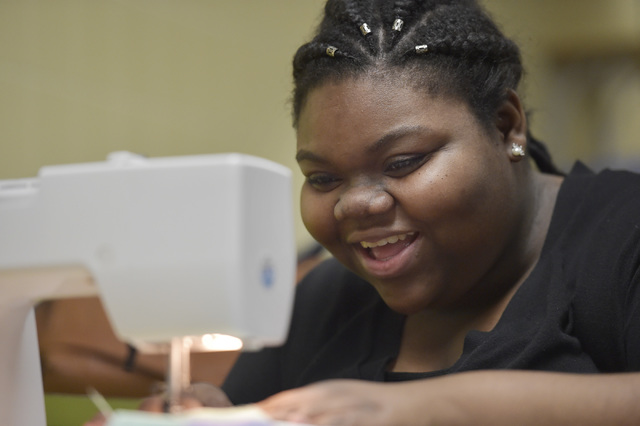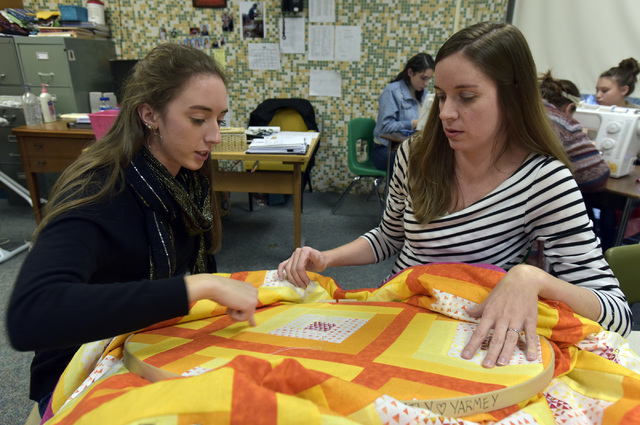
EXETER — At Wyoming Area Secondary Center, one teacher encourages her students to get into cutting and using needles. And many of those students get together once a week after school to do just that.
The group makes up the Wyoming Area Quilt Club, an “exclusive” bunch made strictly of seniors. There’s a slate of officers but little time is spend on business meetings.
“There are about 50 students in the classes,” said club president Kara Dooner. “But about 15 to 20 kids come to the meetings.”
Dooner has started a Facebook page for the club so friends can track quilt progress through photos.
The club also has a mascot — ninth-grader Lucas Naples — who drops by to help out. He’s an extra set of hands for ironing chores or the dreaded seam ripping when the occasional “oops” comes along.
Club members are also working toward a grand quilt show exhibition in the spring, where they can proudly display their efforts. This year, students from Tosca Villano’s art classes will take part in the exhibit, as well. And the groups will do some fundraising with a sale of stitched items like pillows, bags, bibs and other small items, as well as a quilt raffle.
But for now, they drop books and coats at the door and attack the fabric at hand.
“The best part is making something with my own hands,” Nadine Green sasid as she sewed strips of fabric, some bright pink, some gray, mixing patterns and plain cloth.
Everyone in the room already knew the basics. All students at Wyoming Area Secondary Center take sewing classes in seventh and eighth grades to learn about the business end of a needle and how to create with fabric. Many continue in the subsequent years and seniors get to take an actual quilting class. That’s where they learn the finer points of working with a sewing machine and razor-sharp rotary cutter.
The club members start working on their quilts as early as the second week of school. By December, some are still getting started, while others are in the process of sewing fabric together to make blocks.
“It’s like a puzzle, and I love to solve puzzles,” said Kara Moscatelli, whose inspiration was her nonna, who “used to sew all the time.”
Some, like Lauren Shission and Lydia Bugellholl already have their quilt tops finished and are beginning hand-quilting.
And every quilt seems to reflect the personality of its maker.
“I like things Irish, so I went for greens,” said Breanna Cannell, who had a stack of blocks in a log cabin pattern sitting next to the sewing machine. She’s a bit ahead of the game because her mom bought a sewing machine for her about five years ago and she “has been making little things since then.”
For Vanessa Shedlock, it’s a combination of grey and yellow fabrics in sophisticated patterns.
“My room is yellow, so I based the quilt off that,” she said.
She and her fellow quilter, Tahira Sessoms, plan to keep these quilts for themselves. Others in the room have someone in mind for a special gift.
It’s a program that got its start many years ago when the teacher, Antoinette Jones, was a student at Wyoming Area. She said she did some sewing as a “small hobby” as a teenager, especially after the eighth-grade sewing classes at the school.
She always wanted to learn to make a quilt and got started with basics from Mary Poremba, who lived in Plymouth, watched videos on YouTube and read books. And she got her hands on fabric.
“And now, I get to teach what I love in my own alma mater,” she said. “It really doesn’t get better than this.”
For her students, the projects offer many lessons. There’s the common sense work of measuring and calculating quilt sizes.
There’s the artistic side of selecting colors and patterns, learning how they work together and creating designs.
There’s the challenge of learning new skills.
There’s the life goal of working on a project to completion, solving the problems that come up along the way and taking pride in the results of hard work.
It’s also something students carry with them after high school. Many keep in touch and report to their teacher on their post-graduate quilting efforts.
Jones also has plans to expand the program. Up to now, students’ quilts have been fairly basic patterns, but she wants to grow the program and the club into a two-year program where students can advance in their quilt-making skills. There is even an interest in making T-shirt quilts.
“We’re keeping alive something that people were considering a lost art,” she said. “But this is a set of skills that goes beyond the basic school learning and it is something the students never lose once they’ve done it.”