PITTSTON — In the world of pysanky, it doesn’t matter whether the chicken or the egg came first. The only thing that matters is the egg.
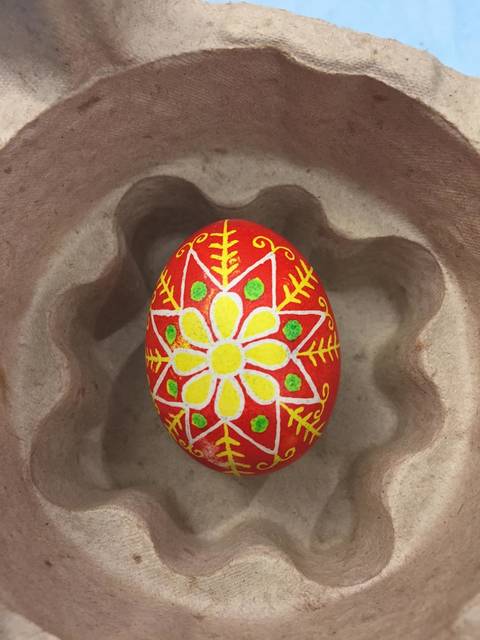
That’s the starting point for the colorful, symbol-laden ovals that grace Eastern European Easter baskets, notably Ukrainian ones, but other cultures in that part of the world also love pysanky eggs.
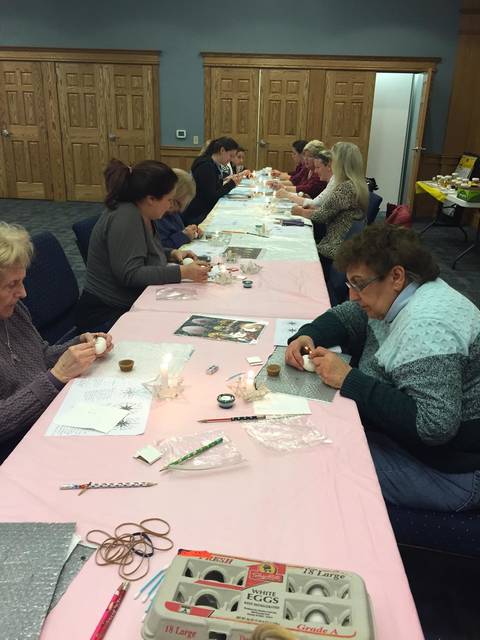
On Monday evening, nearly 20 women made their way to the Pittston Memorial Library to learn the art, the craft and the skills it takes to make their own unique Easter eggs. It was the second year in a row that Pysanky artist Tammy Budnovitch shared her expertise.
The class in the Pittston library is very popular and fills up almost immediately after the library staff announces the date and time.
“I’m of Polish heritage, and many, many years ago, I remember my mother did this,” said Nancy Dopko, as she divided her egg into hemispheres with a light pencil mark. “I did it a little then, but I really don’t remember much about it. So I decided it was time to try again.”
She and her daughter, Angela Bolesta, drove from their Plymouth homes for the class. As well as being a mother-daughter evening, it was a way for Bolesta to be able to share the skill with her husband, Gary.
“He did pysanky with his mom,” she said. “He told me to come home with tips on how to do things better.”
There were only women in the class, but that has long been part of the pysanky tradition, which dates back to pagan times. Only women were allowed to make pysanky and they passed the skill from mother to daughter.
Another mother-daughter team, Pittston residents Teresa Romano and 12-year-old Isabel, were in the class for the second year.
“We did this last year, and it was lots of fun,” Theresa said. “We didn’t buy the dye then, but we wanted to do more eggs. So we came back this year for another class – and to buy supplies.”
After a brief overview of the entire process from the teacher and making a few marks on their eggs as guides for the designs, the class got down to the real business of pysanky. Heads bowed, each heated the metal stylus on what is called the kistka, drew a bit of beeswax into its hollow stem, reheated the kistka and carefully drew on the egg. The wax makes a thin black line.
Once the initial lines create the first design, the egg goes into a light-colored dye. In this case it was yellow.
The students repeated the process, filling in other sections of their designs and putting the eggs into progressively darker dyes. The egg is black after the last dye bath. And that’s when the pysanky creator wipes off all of the wax, revealing the colorful designed egg.
The process can take many hours, depending on the intricacy of the design. Every element of the design carries a meaning, as does every color.
Ginger Murphy, of Pittston, concentrated hard on getting the first lines done well before her egg went into the yellow dye.
“I’m not at all Ukrainian or Slovak – I’m Italian,” she said. “But I have always admired these things when our old neighbor made them.”
Murphy said she often visited and got to see the elderly woman’s collection of pysanky. And after the woman’s death, because Murphy helped to keep her walks shoveled in the wintertime, one of the children offered her an egg as a way of saying ‘thanks.’
That egg is 70 years old, Murphy said.
“Now I want to make pysanky so maybe my children can have them,” Murphy said.
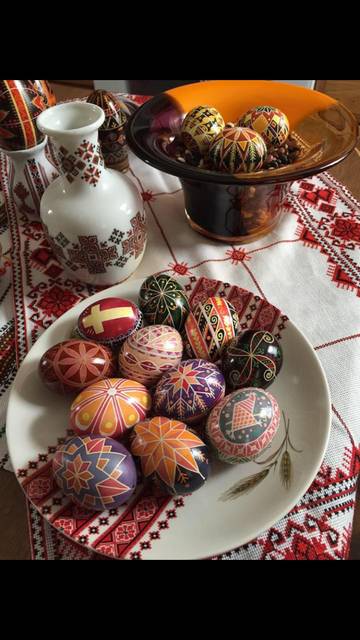
For a bit of inspiration, Budnovitch set up a display of her own work and had tools, beeswax, dyes and even blown-out eggs if her students wanted to experiment on their own after the class.
Eggs can be hollowed out by blowing out the contents or pysanky can be done on raw eggs. If the latter never get a crack, the innards will gradually dry out, Budnovitch said. In either case, the dyed and decorated eggs can last for many years.
Budnovitch, who has a Ukrainian heritage, has been doing pysanky eggs since she was “about 5 or 6” years old under the tutelage of her mother and grandmother. She got started teaching six years ago when she and her mother were invited to be part of a fundraiser at St. Cyril and Methodius Church in Olyphant. That class was a hit and now Easter season is full of teaching for her.
“I love this because it keeps my heritage going,” she said. “So many things will be lost if we don’t share our traditions. I want to keep this one going.”