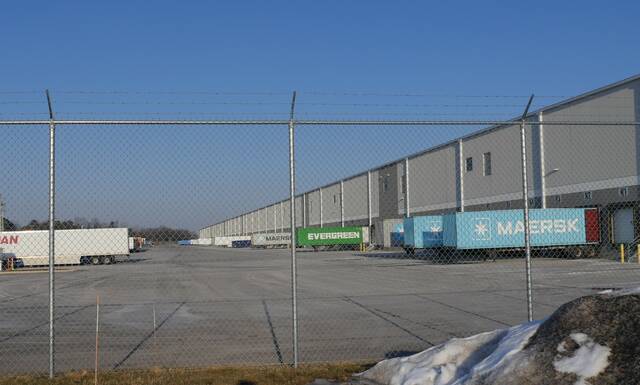
This massive logistics building off Route 309 in Hazleton, owned by NEPA 309 Building LLC, is assessed at $50.8 million and contributing to the city’s tax base growth.
Jennifer Learn-Andes | Times Leader
Highest growth is in Hazleton area
New construction boosted Luzerne County’s real estate tax base by $244.4 million over the past year, with the highest growth in the Hazleton area, analysis of the county assessment office’s latest certification report shows.
A comparison of the January 2025 and 2026 snapshot reports indicates the county’s overall tax base grew 1.12%, from $21.7 billion to $21.97 billion.
This is net growth after factoring in losses from demolition and reductions in assessment challenges.
Of the 76 municipalities, 54 had assessment growth in the past year.
Large-scale commercial and industrial development projects — many on former coal mining land — drove much of the tax base boost. Some are in tax break programs, which means it will take years for municipalities, school districts, and the county to fully realize the revenue.
More than $700 million in assessed property is involved in tax breaks countywide through the Local Economic Revitalization Tax Assistance (LERTA) program for blighted properties, which provides a maximum of 100% forgiveness on the new structure portion of a project for up to a decade.
Still, officials say the certification reports show what’s to come.
“It will be a different world around here,” Jim Montone, Hazle Township supervisor, said in reference to the future revenue influx coming to his municipality when tax breaks expire.
Hazle Township, which wraps around Hazleton city, has the highest total tax base of all 76 municipalities — $1.92 billion. The township claimed the top spot when it surpassed Wilkes-Barre, the county seat, a decade ago.
In this latest one-year cycle, Hazle Township recorded the second-highest assessment growth — $64.7 million, or 3.5%.
Commercial expansion continues at the Humboldt Industrial Park off Interstate 81, and Montone said multiple projects in the works will keep adding value. That includes Mericle Commercial Real Estate Services’ Crossroads East Business Park to house approximately 30 buildings on 1,740 acres primarily along I-81, with an emphasis on manufacturing.
Hazleton
Hazleton was at the head of the pack for growth during this one-year cycle — both dollar-wise and in its percentage.
The city added $72.2 million to its tax base, for a 7.11% increase. That brings Hazleton’s total base to $1.09 billion.
Hazleton Mayor Jeff Cusat said the growth is from both large commercial development and property owners expanding and renovating existing residences and businesses.
The city’s code department also has been proactively searching for building improvements that may have gone unreported in the past so they can be appropriately assessed, he said.
“We have a lot of development going on and a lot of people moving here, buying homes, and investing in their homes,” Cusat said. “People want to be here.”
Available property rarely sits on the market for an extended period in the city, he said.
“Everything is going fast,” he said of real estate.
The city’s population, more than 30,000 and over 60% Latino, has steadily increased, bringing in commercial development, he said.
Cusat said he is closely tracking the assessments of new development in tax breaks to project future revenue.
“Cash flow is very important to progress, and we are full steam ahead in the right direction now,” Cusat said.
County Manager Romilda Crocamo said Hazleton’s highest-growth ranking shows the municipality has “emerged as a leader in generating tax revenue for Luzerne County.”
“For the past few years, I have consistently emphasized that Hazleton is at the forefront of development. However, it has become clear that it is much more than just a development hub. Under the dedicated leadership of Mayor Cusat and the city’s administration, Hazleton has positioned itself as a prime focal point for investment,” Crocamo said.
More growth
Salem Township ranked third in growth, adding $34.2 million, which amounts to a 6.1% increase and brings its tax base to $594.4 million.
John Fogg Jr., Salem Township supervisor, said this increase is tied to the progressing Amazon Web Services (AWS) data center campus.
Fogg is still on the fence about data centers based on his research to date, but he said the tax base growth itself is positive for the municipality.
AWS has not requested a county tax break for the data center, officials said.
Hanover Township was next in line for growth, adding $21.4 million to increase its base by 2.3% to a new total $959.6 million.
Samuel T. Guesto Jr., Hanover Township manager, said the increase stems from “a very nice mixture of commercial and residential construction.”
In addition to several major commercial projects, more than 20 new single-family and double townhomes were constructed in 2025, Guesto said.
He credited township commissioners for leading an “open-for-business model with excellent municipal services” and township code officials for streamlining development from initial planning submission to the occupancy certificate.
Two other municipalities had double-digit growth. Jenkins Township added $13.5 million, elevating its tax base by 2.1% to $658 million.
West Hazleton tacked on $10 million in assessment, or 4.5%, for a new total base of $232.3 million.
Using percentages as a measurement, four municipalities had increases over the 1.1% countywide growth in addition to those already mentioned (dollar growth in parenthesis): Wright Township, 1.4% ($9.1 million); Ross Township, 1.3% ($2.78 million); Pringle, 1.2% ($548,600); and Black Creek Township, 1.15 ($2.8 million).
The remaining municipalities with increases: Pittston Township, $6.7 million; Plains Township, $2.8 million; Harveys Lake, $2.8 million; Sugarloaf Township, $2.6 million; Kingston Township, $2.2 million; Dallas Township, $1.8 million; Butler Township, $1.3 million; Lake Township, $1.2 million; Duryea, $1.2 million; Jackson Township, $1.2 million; Union Township, $990,300; Franklin Township, $916,600; Nuangola, $770,000; Huntington Township, $735,600; Avoca, $652,500; Rice Township, $623,200; Dennison Township, $616,700; Exeter, $522,800; Foster Township, $501,400; Wyoming, $458,000; Hughestown, $443,700; Dorrance Township, $429,000; Newport Township, $422,400; Penn Lake Park, $362,800; Bear Creek, $344,200; Edwardsville, $295,400; Buck Township, $246,100; Conyngham Township, $195,300; Nescopeck Township, $148,100; Lehman Township, $122,900; Warrior Run, $116,000; Laurel Run, $113,700; Swoyersville, $101,500; Nanticoke, $99,200; Dupont, $99,100; Luzerne, $40,600; Slocum Township, $39,300; Yatesville, $38,700; Jeddo, $30,600; Nescopeck, $18,100; Laflin, $8,600; Exeter Township, $7,700; Courtdale, $400; and New Columbus, $300.
Crocamo said the widespread tax base growth is tangible evidence that the county’s economic development push is working to attract businesses and entrepreneurs.
”We are witnessing the positive impact of our community’s commitment to growth, and I am excited about the future opportunities that lie ahead,” she said.
Losses
Wilkes-Barre Township had the greatest tax base decrease —$6.2 million.
Township Mayor Carl Kuren said the figure shows the collective impact of losses due to property assessment appeal reductions. He and other municipal officials said the decline largely forced this year’s 63.6% property tax increase.
The township is “just about out of land” in its primary retail and commercial strips, leaving mine-scarred sections as the only significant option for significant new development to build the township’s tax base in future years, the mayor said.
Wilkes-Barre Township’s assessment loss over the one-year period equated to nearly 1.2%, reducing its tax base to $521.7 million.
The other assessment declines over $1 million: Kingston, $3.4 million; Wilkes-Barre, $2.4 million; Pittston, $1.8 million; Fairview Township, $1.7 million; and Plymouth Township, $1.4 million.
Pittston Mayor Michael Lombardo said the decline is primarily related to assessment appeals and factors related to redevelopment projects, such as demolition.
Lombardo said he is highly confident the tax base will be replenished and grow due to several private development projects that are in the works.
“There are a lot of things brewing,” Lombardo said.
The city had an 18% tax increase this year, primarily to cover rising health insurance costs, but Lombardo said most city homeowners — 96.4% — will pay less in city property taxes than they did last year.
City officials increased a homestead exemption for owner-occupied primary residences, which means $40,000 of the residence’s assessed value is not taxed, compared to the previous $16,500, he said. For example, the owner of a city residence assessed at $100,000 will only pay city taxes on $60,000 of that assessment, he said.
Reach Jennifer Learn-Andes at 570-991-6388 or on Twitter @TLJenLearnAndes.