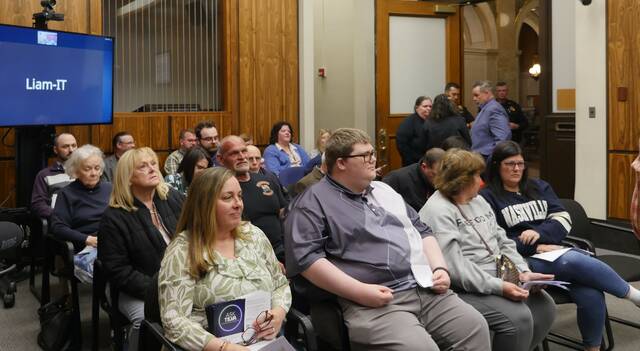
A crowd attended Tuesday’s Luzerne County Council meeting, with some attendees weighing in on a proposed immigration ordinance that failed to receive four votes required for introduction.
Jennifer Learn-Andes | Times Leader
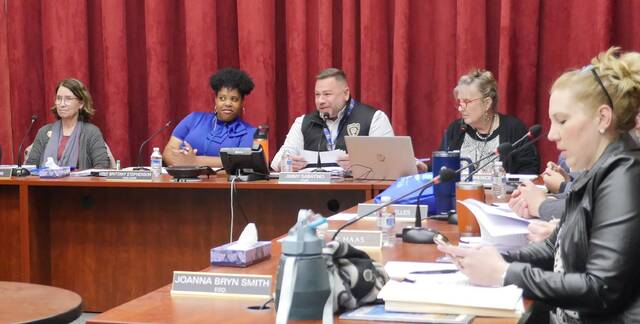
Some Luzerne County Council members are shown listening to a presentation Tuesday. Visible, from left, are: Councilwoman Denise Williams, Vice Chairwoman Brittany Stephenson, Chairman Jimmy Sabatino, council clerk Sharon Lawrence, and Councilwoman Joanna Bryn Smith.
Jennifer Learn-Andes | Times Leader
A controversial immigration ordinance failed to receive four Luzerne County Council votes required for introduction Tuesday, which means the proposal is off the table and won’t advance to a public hearing and final decision through majority vote.
The proposed ordinance prompted nearly an hour of public comment, most in opposition.
County Councilwoman Joanna Bryn Smith proposed the ordinance, which would have prohibited county staff and resources from involvement in federal immigration enforcement unless expressly required by law.
It did not address County District Attorney Sam Sanguedolce’s partnership with U.S. Immigration and Customs Enforcement, or ICE, because that is an elected office, Bryn Smith said.
The ordinance codified “what was already clear under law: that federal immigration law is not the responsibility of the county” and that spending county resources on immigration enforcement “runs contrary to the county’s values and responsibilities to its residents.”
It would have prohibited county departments, commissions, committees, and boards from requesting information about a person’s citizenship or immigration status unless such inquiry or investigation is required by court order or state or federal law. Applications for county benefits and services would have had to be reviewed to delete such questions, if any.
The county also would have been barred from supporting or assisting ICE or other agencies with immigration enforcement operations.
Those voting in support of introducing the ordinance: Bryn Smith, Chris Belles, and Denise Williams.
The council members voting against advancing the proposal: John Lombardo, Harry Haas, LeeAnn McDermott, Chairman Jimmy Sabatino, Vice Chairwoman Brittany Stephenson, Steve Coslett, Dawn Simmons, and Patty Krushnowski.
Thirteen citizens weighed in during public comment — four in support and nine against.
In addition, three residents submitted email comments in opposition. Citizen Ben Herring said another 20 emails were sent urging council to vote against the ordinance introduction, but Sabatino said their submissions cannot be publicly posted because they did not go to the correct public comment address.
Among the ordinance supporters, Wilkes-Barre resident Bianca Mattei-Miller said she will “never support the disappearing of my neighbors” and described the failed introduction as a “deep stain.”
Kingston resident Alan Frank said he is “all for getting rid of bad guys” but believes there is “too much collateral damage” and fear surrounding immigration enforcement, noting he does not want to see ICE agents with all their gear in his town.
Morgan Steiner, of Jenkins Township, said she believes the ordinance is needed and knows residents who are fearful when they are out in public just because they have brown skin.
Speaking in opposition, Duryea resident Gail Malloy said campaign literature from some council members promised a focus on lowering costs for residents, but the proposed ordinance does “just the opposite.”
Hanover Township resident Cory Dunn argued the ordinance could open the county to a legal challenge and costs. Residents have concerns about economic pressures and infrastructure, and the focus should be on “stability and not experimentation,” he said.
Dallas Township resident Alan Pugh said council would not get a “do-over” if the ordinance causes a violent criminal to be released from custody.
Prior county controller Walter Griffith said the ordinance would tell workers they cannot say something if they see something, and he questioned its legality under the county home rule charter and federal law.
Herring, of Duryea, said council would have less public comment if it stops introducing “nonsense ordinances that do nothing,” describing the proposal as a “political stunt.”
State Rep. Jamie Walsh, R-Ross Township, said local government should not “interfere with or block law enforcement from doing its job.” He expressed confidence most of the residents council serves do not agree with the ordinance.
In an email comment, Jenkins Township resident Edmund Zigmund cited his extensive law enforcement experience before retiring and urged them to vote against the “anti-ICE,” “sanctuary ordinance.”
U.S. Rep. Rob Bresnahan Jr., R-Dallas Township, also issued a public statement before council’s meeting urging rejection of the “anti-enforcement immigration resolution.”
The statement said the ordinance would “turn the county into an illegal immigrant sanctuary county.” It also would “limit cooperation with federal immigration enforcement to situations required by law or a court order, while also restricting when county employees can inquire about immigration status,” it said.
“Just last month, an illegal immigrant living in Lackawanna County was arrested for feeding cocaine to and raping a 14-year-old girl,” the statement said.
“We have seen this all over the country: radical Democrats leaving rapists, murderers, and other violent criminal illegal aliens in our communities instead of working with federal immigration enforcement,” Bresnahan’s statement said. “This does nothing but make our communities less safe and attract more criminals to our community because they know the local government won’t work to deport them.”
Reach Jennifer Learn-Andes at 570-991-6388 or on Twitter @TLJenLearnAndes.