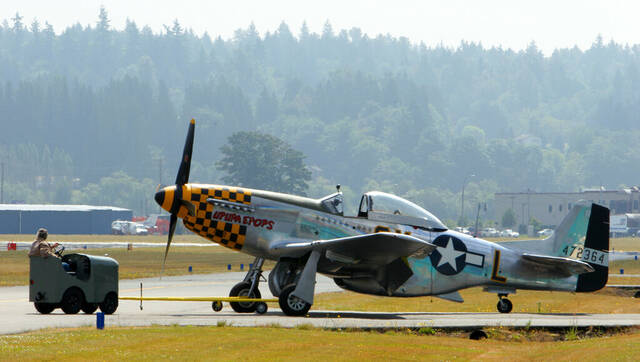
Pictured in 2006, a North American P-51D Mustang is seen being pulled to a hangar. It is just one of the warplanes teased on the flyer for the AirPower History Tour of the Commemorative Air Force, coming to the Wilkes-Barre/Scranton International Airport in June.
AP File Photo
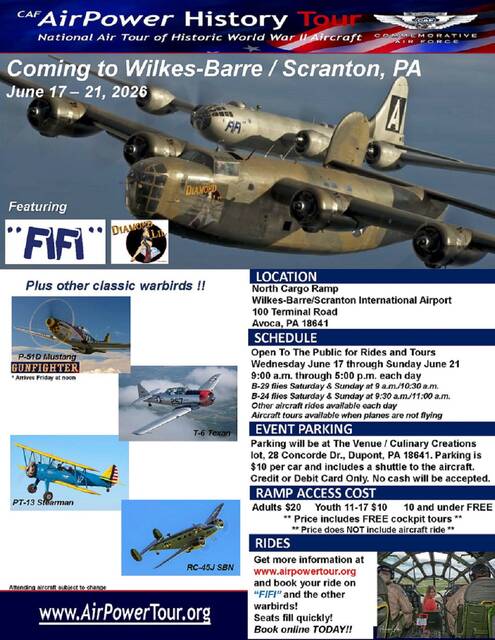
AVOCA — The distinctive rumble of radial engines from two of the rarest World War II bombers — the B-29 Superfortress “FIFI” and B-24 Liberator “Diamond Lil” — will be heard in the skies in June when they visit the Wilkes-Barre/Scranton International Airport as part of the AirPower History Tour of the Commemorative Air Force.
The two bombers are to be accompanied by a T-6 Texan, a PT-13 Stearman, and the RC-45J SNB “Big Oily Beast.”
The P-51D Mustang “Gunfighter” will also make an appearance.
The AirPower History Tour brings the sights, sounds, and stories of World War II aviation to airports across North America each year.
Visitors to the ramp will be able to view all aircraft up close, purchase rides, and tour the B-29 and B-24 cockpits when the aircraft are not flying.
The B-29 and B-24 are scheduled to arrive on Tuesday, June 16, at noon. Accompanying aircraft are scheduled to arrive on Tuesday as well. The P-51D will arrive on Friday, June 19, at noon.
The aircraft will be staged at the North Cargo Ramp, located at Wilkes-Barre/Scranton International Airport, 100 Terminal Road, Avoca.
Parking for the event will be at The Venue/Culinary Creations lot, 28 Concorde Dr., Dupont. Parking is $10 per car and includes a shuttle to the aircraft location. Credit or debit card only. No cash will be accepted.
The event will be open to the public Wednesday through Sunday — June 17 through June 21 — from 9 a.m. until 5 p.m.
Access to the ramp where the warbirds are parked is $20 for adults, $10 for children ages 11-17, and free for children 10 and under.
The T-6, the PT-13, and the RC-45J will be offering rides each day. The P-51D will be offering rides beginning at 1 p.m. on Friday. The B-29 flies on Saturday and Sunday at 9 a.m. and 10:30 a.m. The B-24 flies on Saturday and Sunday at 9:30 a.m. and 11 a.m.
Cockpit tours of the B-29 and B-24 will be available each day beginning at 9 a.m., except on Saturday and Sunday, when they will begin at noon.
Rides may be booked in advance at AirPowerTour.org where additional information about the event may also be found.
About the B-29 Superfortress “Fifi”
The Boeing B-29 Superfortress — the largest and most technically advanced aircraft of its time — was first flown in 1942.
It began active service in the U.S. Army Air Corps in 1944 and is best known as the aircraft whose missions over Japan helped bring an end to World War II.
The B-29 was also used in the Korean War in the early 1950s and was a staple of the U.S. Air Force until 1960.
“FIFI” — one of only two B-29s in the world still flying — was acquired by the CAF in 1971. She began touring in 1974 and has been entertaining air show audiences across the country ever since.
About the B-24 Liberator “Diamond Lil”
The Consolidated B-24 Liberator was the most-produced American warplane of WWII, with more than 18,400 aircraft rolling off assembly lines across the country. Most were manufactured at Ford’s giant Willow Run assembly plant in Detroit.
Diamond Lil — one of the first B-24’s produced and still one of only two B-24’s in the world still flying — provides the opportunity to experience the sights and sounds of our fathers and grandfathers in the dangerous air wars over Europe, the Pacific, North Africa, and Asia.
About the P-51D Mustang
The North American P-51D Mustang is one of the most recognizable and loved aircraft in aviation history.
With its speed, range, and sleek lines, the P-51 became a favorite of Allied fighter pilots and bomber crews.
The long-range fighter aircraft had a range of 1,300 miles, enabling it to accompany the bombers to their targets and back, and it was faster and more maneuverable than its German and Japanese opponents.
About the T-6 Texan
The North American T-6 Texan — known as the “Pilotmaker” — was an advanced flight trainer that introduced new pilots to a complex aircraft capable of speeds over 200 miles per hour, preparing them for the warbirds they would fly in combat in WWII.
The T-6 was designed for an instructor and student and had a closed cockpit.
About the PT-13 Stearman
The Boeing PT-13 was the primary flight trainer for all branches of the military during World War II.
This iconic biplane — almost universally known as the “Stearman” — trained more crews than any other aircraft in WWII.
A ride in this open cockpit airplane brings back the wind-in-your-hair feeling of the early days of flying.
About the RC-45J SBN
The Beech SNB is a US Navy/Marine variant of the civilian Model 18 Twin Beech.
Over half of the 10,000 produced from 1937 to 1970 were for the U.S. military, and were used for light transport, photo-reconnaissance, navigation, bombing, and gunnery training.
Many Twin Beech aircraft survive today after serving post-military as relatively inexpensive, reliable light cargo aircraft.
About the Commemorative Air Force
Through more than six decades of collecting and flying World War II aircraft, the CAF has become the world’s largest flying museum. Their fleet of more than 170 World War II airplanes is assigned to unit locations across the U.S. and is supported by 12,000 volunteer members.
Nearly all the aircraft are kept in flying condition, enabling people to experience first-hand the sight and sound of vintage military aircraft in flight.
The CAF is dedicated to honoring American military aviation through flight, exhibition, education, and remembrance.
To learn more, visit www.commemorativeairforce.org.