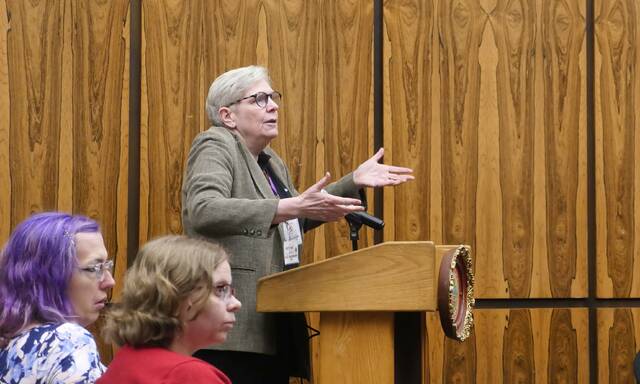
Liz Bradbury, chair of the Lehigh County Human Relations Commission, attended Tuesday’s Luzerne County Council work session to discuss a proposed anti-discrimination ordinance here, saying she will provide training at no cost. Seated, from left, are ordinance advocates Shayla Lovenduski and Caela Bernecker, of West Wyoming.
Jennifer Learn-Andes | Times Leader
Public input on Luzerne County’s proposed anti-discrimination ordinance continued this week, and more feedback is expected.
The legislation would create a county human relations commission to rule on discrimination complaints extending beyond county government to include employment, housing, healthcare, education, and establishments that sell goods and services to the general public.
As previously reported, Council Chairman Jimmy Sabatino wants a special, standalone public hearing because he believes there are “a lot of residents of Luzerne County that want to chime in” on the proposed ordinance.
The public hearing will be at 5:30 p.m. June 4 in the county courthouse on River Street in Wilkes-Barre, and a final council vote is set for June 9.
Fairview Township resident Michele Kessler, a retiree, told council during Tuesday’s work session she is enthusiastic about the proposal and wishes it had been in place throughout her work years.
Kessler said some other counties and cities in the state have successfully implemented similar ordinances, and she believes residents of this county “also deserve this.”
She predicted the approach would be a “valuable tool” that reduces conflict and resolves issues in an “economical, fair and expeditious way.”
“Thank you all for creating an even better Luzerne County,” Kessler said.
Wilkes-Barre resident Andrea Glod said action is warranted because she believes the current level of discrimination “has not been seen in our country since the 1960s.”
Caela Bernecker, of West Wyoming, said she has experienced discrimination as a member of the LGBTQ+ community in a restaurant and elsewhere. The proposed county ordinance expands protection to classes currently not covered in state and federal laws, she added.
“Anything that makes you different in this world can lead to that discrimination, and the truth is it should never feel like privilege not to be discriminated against,” Bernecker said.
Bernecker’s fiancé, Shayla Lovenduski, of West Wyoming, said the ordinance would help a “marginalized group of people be able to survive.”
A state and nationally-certified emergency medical technician, Lovenduski said she was denied EMS jobs by three entities in the county and informed in all three instances it was “based on the fact that I’m transgender.”
Lovenduski said many past immigrants experienced the hatred and discrimination now felt by the LGBTQ+ community, and it should not be continuing “in this day and age.”
Sandra Jones, also of West Wyoming, said she lives in fear that transgender friends and family members will be attacked.
“I have seen hate from people who have not even spoken to them,” Jones said.
Luzerne resident Tom Nankivell, a teacher for nearly 22 years, encouraged council to approve the ordinance, saying he would be “one of the first in line” to volunteer as a commission member.
Expressing an opposing view, Plains Township resident Joe Granteed said he does not believe county government should “get in the middle” of such matters, describing it as a “real slippery slope.”
Prior county controller Walter Griffith said he is concerned about the impact on employers and their hiring, describing the county proposal as “government overreach at its finest.”
Liz Bradbury, chair of the Lehigh County Human Relations Commission, attended Tuesday’s session and told council she is willing to train Luzerne County residents involved in a commission if one is created here. Sabatino said a separate ordinance outlining the commission’s structure would be necessary if the anti-discrimination ordinance passes.
Bradbury said local commissions are needed because it currently takes two to three years for the state to process discrimination complaints, and there is a backlog of approximately 1,700 cases at the state level.
Local anti-discrimination ordinances also serve as a “stop sign,” as many entities will proactively take steps on their own to ensure compliance and avoid complaints, Bradbury said.
Council Vice Chairwoman Brittany Stephenson said she is “very excited to support this ordinance,” citing the state backlog.
Stephenson said she has received many calls from citizens in favor of the ordinance and regularly interacts with people who are “actively discriminated against” and have no “direct avenue” to efficiently address their concerns.
“I think it is our responsibility to find better ways to protect the citizens that live in Luzerne County,” Stephenson said.
Reach Jennifer Learn-Andes at 570-991-6388 or on Twitter @TLJenLearnAndes.