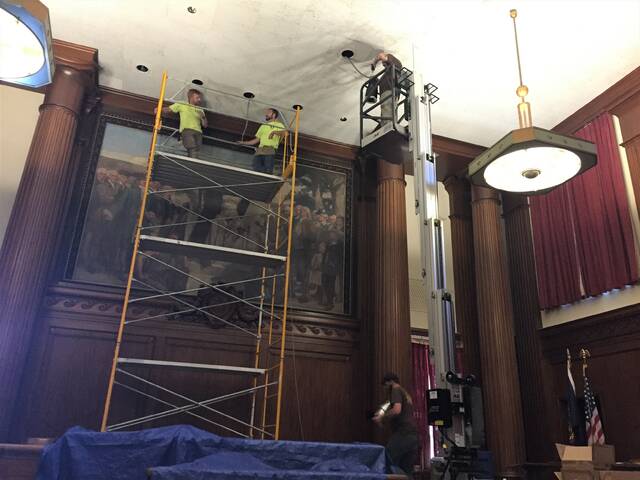
Luzerne County Courthouse courtrooms became more illuminated through a LED lighting project in 2018, but officials say a larger scale restoration project is needed.
Photo courtesy of William McIntosh
Much work to be done in third-floor courtrooms
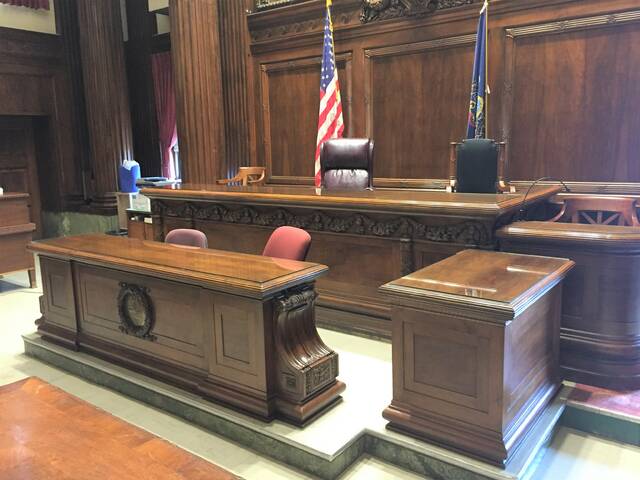
This Luzerne County Courthouse judicial bench was restored as part of a test case during the last restoration project, and officials say work is needed in all four courtrooms on the third floor.
Photo courtesy of William McIntosh

An example of plaster damage below a Luzerne County Courthouse courtroom window that must be repaired.
Photo courtesy of William McIntosh

McIntosh
All three Luzerne County manager finalists expressed support for finishing restoration of the historic courthouse when council asked about the topic last week — raising questions about what major work remains.
County Engineer William McIntosh said the primary lingering project would address the four large, third-floor courtrooms that have not been restored in decades, and he said there is no recent accurate estimate on what it would cost.
Completed in 1909, the courthouse on River Street in Wilkes-Barre is on the National Register of Historic Places.
“I couldn’t even give you a wild guess on the cost,” McIntosh said of the courtroom phase. “In the third-floor courtrooms, there’s a lot that needs to be done. They haven’t been touched in years.”
The floor tiles in the four courtrooms are worn and popping up, he said. In past decades, new flooring had been placed atop the old, resulting in layers that should be removed to start with a fresh base, McIntosh said. This approach would require temporary removal of the rows of courtroom gallery benches resembling pews, he said.
Plaster repairs are necessary to address damage from past leaks, he said.
The courtroom curtains must be replaced because they deteriorated from sun and age. They are “literally falling down” and can’t be opened due to jammed mechanisms, McIntosh said.
Courtroom ceilings also must be addressed, he said. The drop ceilings were added at one point to accommodate air conditioning. Repairing isolated sections would be a challenge because the fibrous material interlocks, as opposed to a system of individual tiles that rest on a grid, he said.
As part of the project, McIntosh also suggests minor electrical upgrades to accommodate new technology used in the courtrooms, saying the courts have been forced to extend wiring across the floors and use tape or other means to cover it.
The antique wood tables and judicial benches also must be cleaned and restored, he said.
He does not know if restoration of historic paintings in the courtrooms would be part of the next phase because it would require costly specialists.
While the project has remained on the back burner, McIntosh noted he was able to make the courtrooms brighter in 2018 by installing more cost-efficient LED lighting ceiling fixtures that replaced ones dating back decades. That project cost $9,100, which was a significant savings because he and other workers handled much of the work in-house.
The LED lights should illuminate for 100,000 hours, alleviating the burden on building and ground workers who had to regularly climb a 14-foot ladder and hold up a homemade tool involving a pole and cork to change burned-out bulbs, officials said.
McIntosh cautioned a contingency reserve also would be needed for the courtroom project because other repair needs may surface if contractors discover further underlying damage.
Court efforts
Court Administrator Paul Hindmarsh said additional lighting also is needed in the courtrooms.
Time-consuming restoration of the woodwork would be involved because the courtrooms have ornate judicial benches, witness area and other tables, he said.
As a test case, one judge’s bench in courtroom 2 was addressed in the last phase of courthouse restoration.
“They polished the heck out of it, and it looks wonderful. We even put some glass on top of the bench to help further preserve the integrity of the surface from oils and writing,” Hindmarsh said.
Court officials have been seeking outside funding to offset the costs of the courtroom restoration, although Hindmarsh said it is a challenge because most of the available grants focus on specific services or equipment, such as new technology.
Finalist feedback
Out-of-the-area manager finalists Randy Robertson and David W. Johnston stepped inside the courthouse for the first time last week when they were interviewed for the top manager position, and both paused to admire the restored rotunda.
County Acting Manager Romilda Crocamo, also a finalist, has repeatedly described the structure as an “architectural gem.”
Robertson said the county’s courthouse is on par with some state capital buildings. The county’s courthouse is an “institution of the people” that couldn’t be replicated today, he said. The structure will be standing a long time, and the county should finish the restoration project, he said.
Crocamo told council the county’s courthouse is more beautiful than the many courthouses she has visited across Pennsylvania and in other states.
Johnston said the courthouse is “gorgeous” and that its preservation should remain a priority.
Capital funds
The county has invested millions of dollars in borrowed funds on courthouse repairs and restoration since officials started making preservation a renewed priority in the years leading up to the structure’s 100th anniversary in 2009.
Leaks had damaged the plaster and artwork in the rotunda.
Starting at the top, the skylight was replaced to keep water out and allow more sunshine to filter through the freshly cleaned and refurbished stained glass below, including 15 panes depicting the circular county seal.
Other exterior repairs included work on the roof, the domes and Ohio sandstone facade.
With the leaks addressed, the most recent phases focused on artwork and finishes in the rotunda, foyers and hallways.
The county also replaced the windows as part of an energy efficiency initiative.
McIntosh said the structure is “very well built.”
“It’s a big building, and you constantly have to maintain it, but if we keep up with it, we won’t fall behind like the county did before,” he said.
Reach Jennifer Learn-Andes at 570-991-6388 or on Twitter @TLJenLearnAndes.