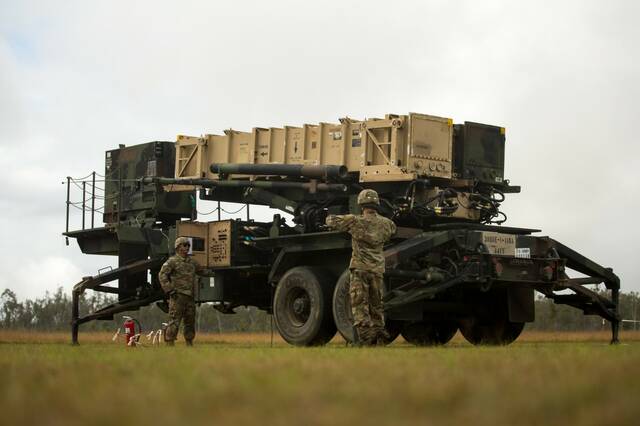
U.S. Army Sgt. Tamayo Ezekiel (left) and U.S. Army Pfc. Colby McCormick (right), Army Patriot Launching Station Enhanced Operators, raises the MIM-104 Patriot launching station Jul. 14, 2021, at Camp Growl in Queensland, Australia, during Exercise Talisman Sabre 2021. TS 21 supports the U.S. National Defense Strategy by enhancing our ability to protect the homeland and provide combat-credible forces to address the full range of potential security concerns in the Indo-Pacific.
Courtesy of Tobyhanna Army Depot
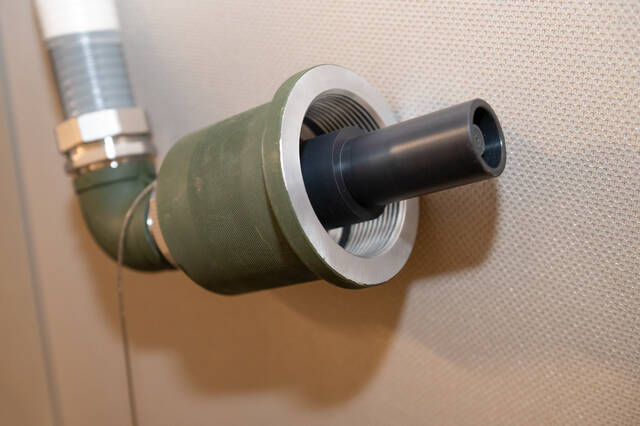
Since earning the mission, a versatile team of artisans from several areas of the depot has contributed to the fabrication of two prototypes to date and is funded for 27 more with slight variations.
Courtesy of Tobyhanna Army Depot
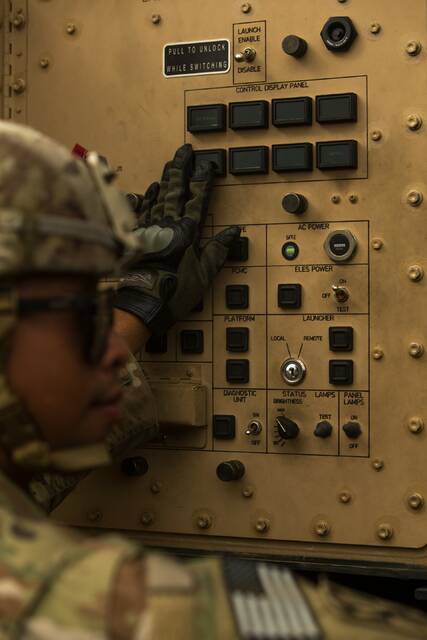
U.S. Army Sgt. Tamayo Ezekiel, an Army Patriot Launching Station Enhanced Operator section chief, finds the MIM-104 Patriot address and turns on the missile heaters July 14, 2021, at Camp Growl in Queensland, Australia, during Exercise Talisman Sabre 2021. TS 21 supports the U.S. National Defense Strategy by enhancing our ability to protect the homeland and provide combat-credible forces to address the full range of potential security concerns in the Indo-Pacific. Ezekiel is a native of Anchorage, Alaska.
Courtesy of Tobyhanna Army Depot
Over the course of Tobyhanna Army Depot’s service to the nation, its leadership has shown an uncanny ability to anticipate the needs of warfighters on an ever-evolving battlefield. This example is no exception and is the reason why Tobyhanna earned this mission.
Courtesy of Tobyhanna Army Depot
Tobyhanna Army Depot is engineering more efficient ways to power a vital air and missile defense system.
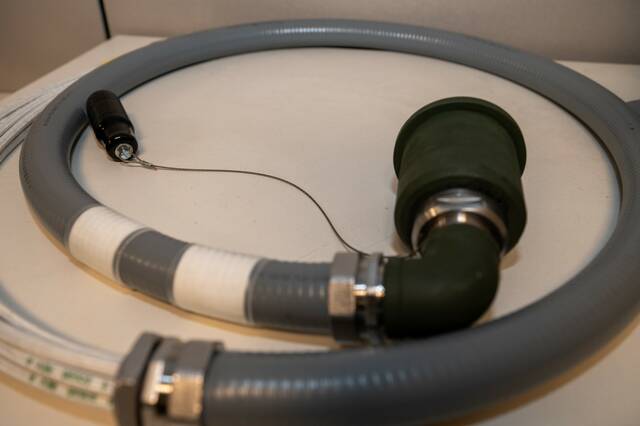
In 2024, CECOM identified both cost and time deficiencies in the cable assembly for the Electric Power Plant III – a power generator for the MIM-104 Patriot air defense system. The nation turned to the dynamic civilian workforce at Tobyhanna Army Depot to quickly, affordably, and precisely reverse-engineer the cables powering this vital equipment for warfighters.
This effort, according to Tobyhanna Army Depot Design, Development & Fabrication Division Chief Chase Gardner, of Pittston Township, “ties directly to Department of War transformational strategies getting the war fighters what they need faster, cheaper, and organically.”
Since earning the mission, a versatile team of artisans from several areas of the depot, including Design, Development, and Fabrication Division; Cable and Electrical Fabrication Division; Machining and Mechanical Development Branch; and Component Preparation and Plating Branch, have contributed to the fabrication of two prototypes to date and are funded for 27 more with slight variations. The comprehensive effort has included reverse-engineering the connectors, re-engineering the entire cable (connector, housing, and assembly), and creating models, drawings, and a technical data package for CECOM.
Gardner said the use of an international company to manufacture the cables was resulting in significant cost and over 12 months of lead time for cable connectors in low quantities alone.
“You had $20,000 cables red lining $1,000,000 weapon systems that are our number one air defense mitigation in contested areas. We know for a fact the reason the cables were taking over a year was because of the connectors,” said Gardner.
Over the course of Tobyhanna Army Depot’s service to the nation, its leadership has shown an uncanny ability to anticipate the needs of warfighters on an ever-evolving battlefield. This example is no exception and it is the reason Tobyhanna earned this mission.
Gardner said Tobyhanna had been developing an organic cable connector capability and was keen to expand it during the depot’s briefing. One person attending the briefing was someone instrumental to Tobyhanna securing this work – Lee Straube, Associate Director Technology, CECOM Integrated Logistics Support Center.
Upon hearing that Tobyhanna could provide an organic supply of cables that could be produced more cheaply and quickly, Gardner said Straube set his sights on Tobyhanna.
Straube has been extremely impressed with the latest success to emerge from Tobyhanna’s production floor.
“Because of Tobyhanna, we now have our first domestic source. Tobyhanna is making the cables at half the price and cutting way back on our production lead times, so it’s a win-win for CECOM and the U.S. Army,” said Straube.
Tobyhanna Army Depot Field Engineer Matthew Check said a project like this allows the depot’s workforce to showcase what they are capable of.
“I think a mission like this shows that we could reverse engineer, re-engineer, and fabricate complex cables like this as well as machine connectors and housings that others may not have the ability to do,” said Check.
While the immediate priority for the team on this mission will be the fabrication of the 27 additional prototypes, Gardner sees this effort as the start of something much bigger for Tobyhanna, the Department of War, and the warfighters it serves.
“We hope a mission like this demonstrates the capability for an organic connector manufacturing source of supply across the Department of War. This is Tobyhanna’s first step in demonstrating that capability and a good use case for the community as to why an organic source makes sense.”
Tobyhanna Army Depot (TYAD) is designated as the Center of Industrial and Technical Excellence for Command, Control, Communications, Computers, Cyber, Intelligence, Surveillance and Reconnaissance (C5ISR), electronics, avionics, and missile guidance and control. TYAD provides cradle-to-grave lifecycle support through depot-level repair, systems integration, software and cyber engineering, and field support. A key enabler of operational readiness for Joint and Allied Forces globally, TYAD leverages new and emerging technologies to further expand the Department of Defense’s organic capabilities for microelectronics, secure communications infrastructure, unmanned aerial systems, Joint All-Domain Command and Control (JADC2), Integrated Air and Missile Defense (IAMD), and the Army’s Next Generation Combat Systems (NGC2). TYAD’s ability to rapidly surge production, deploy field support teams, and scale for contingency or theater-level operations makes it a vital contributor to strategic readiness and operational reach.
Tobyhanna Army Depot (TYAD) is designated as the Center of Industrial and Technical Excellence for Command, Control, Communications, Computers, Cyber, Intelligence, Surveillance and Reconnaissance (C5ISR), electronics, avionics, and missile guidance and control. TYAD provides cradle-to-grave lifecycle support through depot-level repair, systems integration, software and cyber engineering, and field support. A key enabler of operational readiness for Joint and Allied Forces globally, TYAD leverages new and emerging technologies to further expand the Department of Defense’s organic capabilities for microelectronics, secure communications infrastructure, unmanned aerial systems, Joint All-Domain Command and Control (JADC2), Integrated Air and Missile Defense (IAMD), and the Army’s Next Generation Combat Systems (NGC2). TYAD’s ability to rapidly surge production, deploy field support teams, and scale for contingency or theater-level operations makes it a vital contributor to strategic readiness and operational reach.