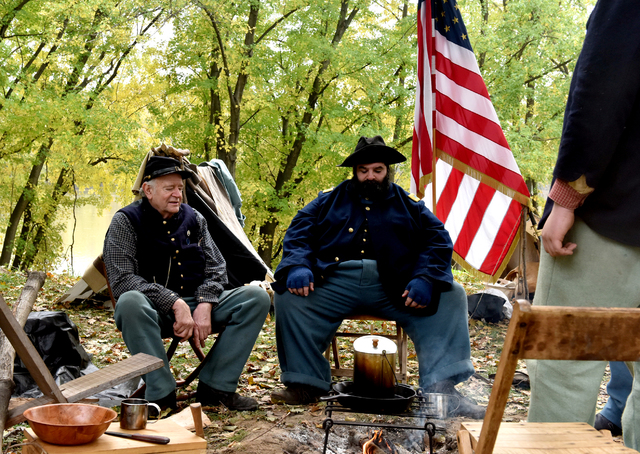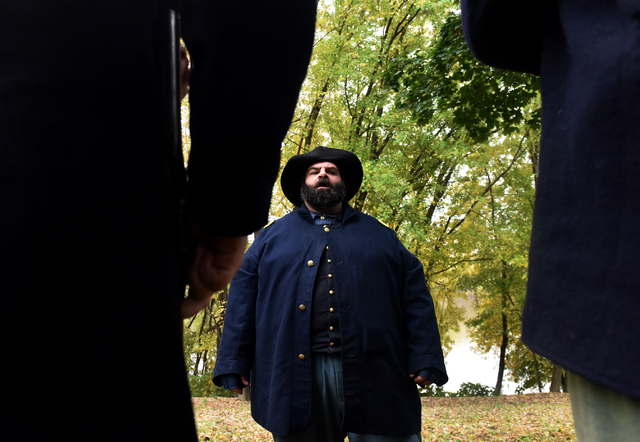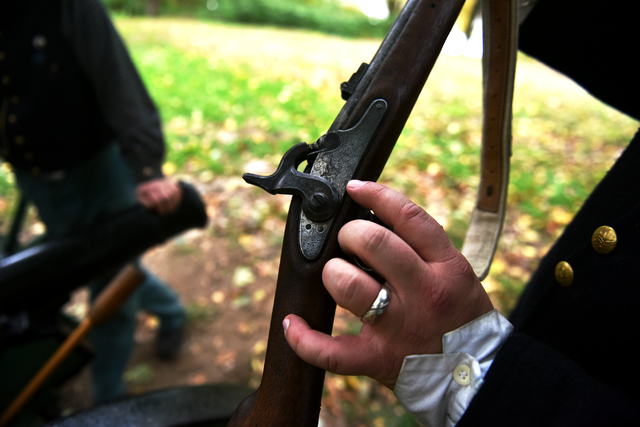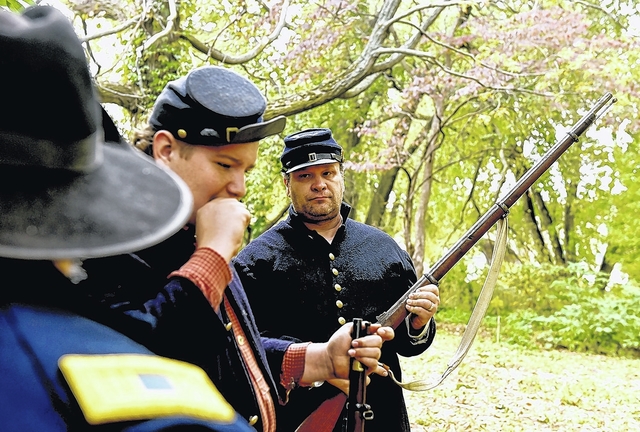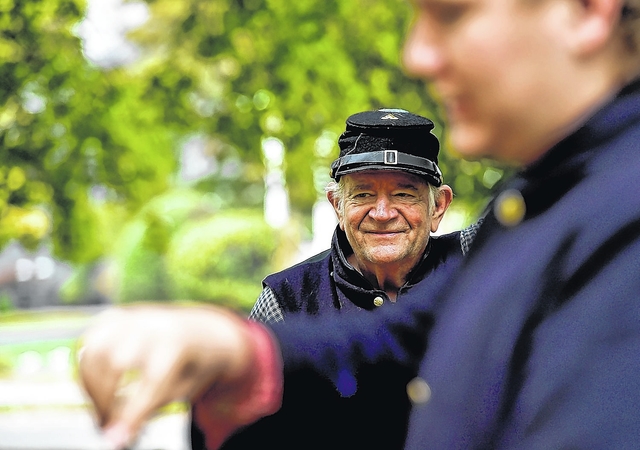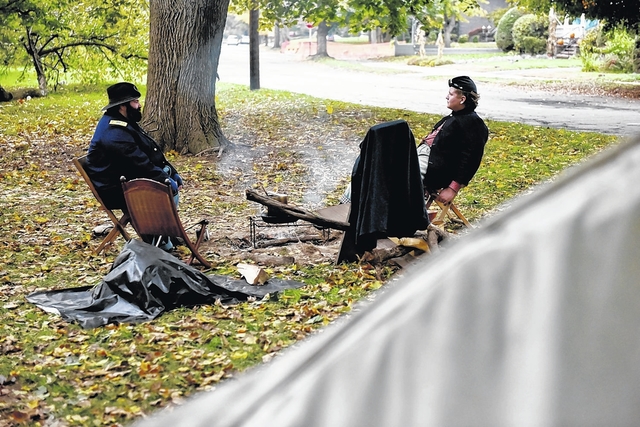
WEST PITTSTON — Civil War re-enactors from the 143rd Pennsylvania Volunteer Regiment who set up camp on the banks of the Susquehanna River last weekend enjoyed bringing a bit of history to area residents in an authentic setting.
Despite falling temperatures and the threat of rain, the re-enactors who camped near the borough’s two bridges embraced the opportunity to experience the same challenges of those who served in the federal unit during the Civil War.
The group’s mission is “to honor the brave men who fought and died to preserve the Union by accurately portraying 19th century soldier life and duty,” according to the organization’s website.
Participants, like the soldiers they were portraying, faced hardship with courage.
Peter Cangemi, representing a captain, said he had no problem sleeping, thanks to three heavy wool blankets.
“If I poked my hands out, though,” he said, “it was really cold.”
Participants in the re-enactment didn’t go hungry, appreciating the warmth from a small fire perfect for cooking a cheese and rice dish, with a bit of bacon added.
Bruce Geiger said that in addition to shedding light on military history of the area, the event also served to make good on a promise made over 100 years ago.
“We promised those men who fought in the Civil War that they would not be forgotten,” he said. “We are keeping that promise with each re-enactment.”
Geiger, who seemed perfectly acclimated to camping next to a river with no comforts of home, said he’s been a Civil War buff since he was 10.
In addition to war history, the re-enactors made the life of those who fought come alive for attendees.
“Everything they wore was wool,” said Austin Neagle, portraying a corporal. “And their brogans (boots) were always leather.”
Geiger said that although the wool was hot in the summer, it hit a tipping point when it would serve almost like air conditioning.
“You would sweat so much, and then the air would make its way through the wool and you start to cool off,” he said.
Interesting, Neagle said, is that the unit trained “just down the road,” in Luzerne Borough near what is now Bennett Street.
Each re-enactor was prepared with endless historical facts, like a walking textbook for those who wanted to know more about the life of soldiers during the war, its battles and its conclusion.
The campsite reminded attendees of the sacrifices made by soldiers during war.
Tents used for sleeping were very small, and one could only imagine attempting to fit an adult male comfortably into one.
“They were called dog tents,” said Geiger, “probably because they were big enough for a dog.”
Geiger said it was common for soldiers to put two of the small tents together to conserve body heat.
It was apparent that the re-enactors fully enjoyed their weekend experience, citing the friendliness of attendees and opportunity to spend time with like-minded friends.
Wes Mitchell, who’s been a re-enactor for about five years, said he especially enjoyed time spent in Gettysburg learning about the experience of soldiers who fought there.
And while striving to provide an authentic experience to participants and attendees, the group was not above using a bit of technology to improve the quality of their experience.
Booting up his new electronic tablet, Geiger said, “We use it to find out what weather is on its way.”