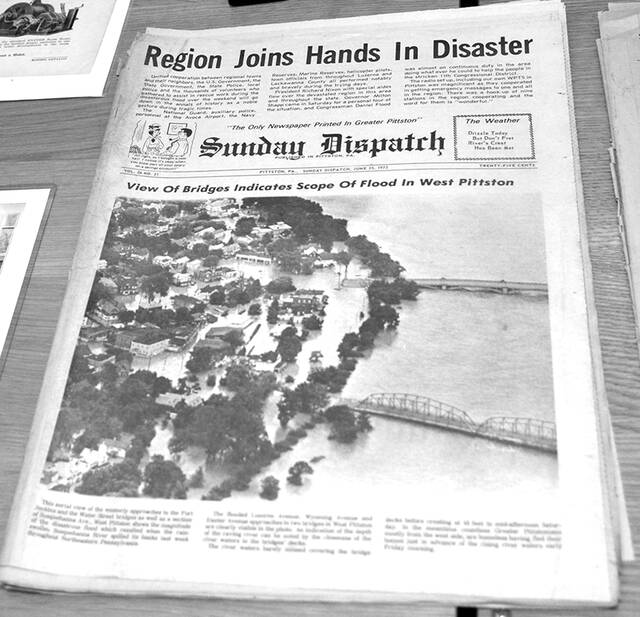
Shown is a Sunday Dispatch from June 25, 1972, just days after the Agnes Flood that devastated West Pittston and the entire Wyoming Valley.
Tony Callaio file photo | For Sunday Dispatch
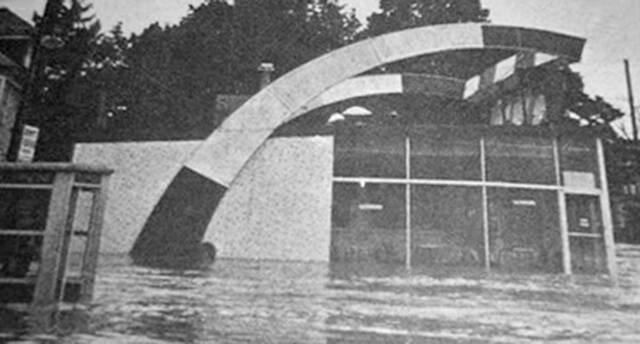
This file photo is the former Top Spot restaurant in 1972, now Antonio’s, on the corner of Wyoming and Luzerne avenues.
Times Leader File photo
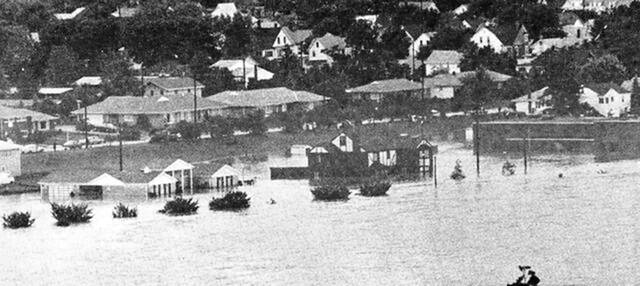
This Times Leader file photo was snapped from the east side of the Susquehanna River looking towards the West Pittston Armory, far right, along with houses lining on Susquehanna Avenue.
Times Leader File photo
WEST PITTSTON — As each year and each generation goes by, so do the vivid memories of the actual event.
Most people who can remember the flood had to be between five and 10 years old at the time, and even at those ages, it might be a stretch to recall a single thing.
I was a few months shy of turning 15 when the Susquehanna River overflowed into the streets of municipalities in Wyoming Valley.
We were in summer session at the time of the flood and days before levees broke, Tropical Storm Agnes was churning in the Gulf of Mexico. At that point in time, no one had a clue the storm would be that powerful and carrying that much moisture north to Pennsylvania.
Northeast PA had already experienced a great deal of rain soaking the ground saturating it everywhere. As I recall, the rain was massive and I had not witness so much rain at such a heavy pace in my recent recollection, but then again, I was only 14.
Not only did it rain in northeast PA, but also it rained heavily in upstate New York where the source of the Susquehanna begins eventually raising river’s levels.
It was the beginning of the perfect storm to create the region’s largest flood in its history.
By the morning of June 22, the Susquehanna rose to an unusual height causing alarm to Luzerne County officials, so much so, they ordered residents of low-lying neighborhoods to begin to evacuate their homes.
On Friday afternoon, June 22, flooding occurred in low-lying areas causing more evacuations under the supervision of local police, firefighters and the National Guard was called in for backup.
As the rain fell harder and flooding continued, roads and bridges became impassable. Power outages began affecting parts of the valley.
There was a basketball marathon being held at Wyoming Area’s Montgomery Avenue School where I had permission to attend during the night by my parents.
While the game was continuing, someone came into the gym and made the announcement the Susquehanna was starting to come over its banks.
Since I wasn’t a participant in the game, I was curious to see where the river advanced.
After the short walk to the Susquehanna River bank, people were milling about everywhere.
Residents on Susquehanna Ave. were standing on the riverbank marking the waterline every hour on the hour to see how far the river was rising. And it was rising rapidly.
At one point in time, family friends saw me walking past their home and asked me to help them carry their porch furniture into the house. In retrospect, that did not help. They eventually had their entire first floor inundated.
These are very vivid memories for me 54 years later, but the most memorial thoughts are not only embedded in my mind, but what I smelled will never leave me. To this day I can smell flood mud as if it happened yesterday.
The closest event that can rival Agnes was Tropical Storm Lee that took place in 2011. The big difference was Lee only affected extreme low-lying areas, was West Pittston, who ended up losing over 25 properties to Lee.
The months and months of clean up through the valley seemed impossible. The canyon of debris on both sides of Wyoming Avenue had to be 10’ to 12’ high.
After the mud tried up, many wore facemasks to prevent breathing in mud dust.
There was so much pain and suffering through our region, but we everyone banded together to help each other get through the worst disaster that ever hit Wyoming Valley.
Somewhere along the line, someone painted on a wall, “The Valley with a Heart.” It best described how the feeling and attitude of the time.
Agnes facts
• The Susquehanna River reached 40.9 feet at Wilkes-Barre, a record level at the time and well above the protection offered by existing flood-control systems.
• Flood elevations in the Wilkes-Barre and Pittston area exceeded the historic floods of 1865 and 1936 by about eight feet.
• Greater Pittston, West Pittston, Wyoming, Exeter, Forty Fort, Kingston, and Wilkes-Barre were all heavily inundated when the Susquehanna overflowed its banks.
• Thousands of residents were evacuated from communities throughout the valley as floodwaters rose rapidly. Entire neighborhoods disappeared beneath muddy water.
• In Luzerne County alone, approximately 25,000 homes and businesses were damaged or destroyed. Losses were estimated at about $1 billion in 1972 dollars.
• In downtown Wilkes-Barre, Public Square was covered by nearly nine feet of water.
• The floodwaters reached the second floors of some homes along the river communities of the Wyoming Valley.
• At the cemetery in Forty Fort, floodwaters washed away approximately 2,000 caskets, creating one of the most disturbing scenes associated with the disaster.
• Many businesses in downtown Pittston, West Pittston, Kingston, and Wilkes-Barre never reopened after the flood.
• The disaster struck at a time when the Wyoming Valley was already suffering from the decline of the anthracite coal industry, making economic recovery even more difficult.
• Across the United States, Agnes caused 117 deaths and approximately $3.1 billion in damage, making it one of the costliest natural disasters in American history at that time.
• The flood changed how Pennsylvanians viewed flood protection and emergency management, leading to major improvements in levees, flood walls, warning systems, and evacuation planning.
• The Agnes Flood remains the benchmark by which older residents of the Wyoming Valley measure every subsequent flood event.
• The floodwaters left behind a thick layer of mud, fuel oil, sewage, and debris that took months to clean from homes and businesses.
• Schools throughout the valley were closed for extended periods, and many families lived in temporary housing while rebuilding.
• The federal government declared the area a major disaster zone, bringing in emergency aid and reconstruction assistance.
• More than 50 years later, residents who lived through Agnes often describe it as the single most traumatic event in the modern history of the Wyoming Valley.